


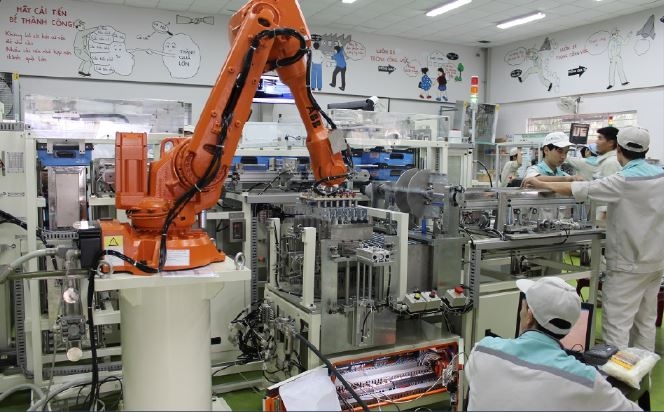
Backed by strong policy commitments, emerging “Lighthouse” factories, and growing demand for greener, more resilient supply chains, Vietnam is positioning itself to compete at the frontlines of advanced manufacturing. The window of opportunity is wide open, industry leaders and global partners have said, but seizing it will require speed, strategy, and sustained innovation.
Shift to ‘Lighthouse’ factories
Opening the panel discussion on “Smart Manufacturing and Global Supply Chains” at the recent Autumn Economic Forum 2025, Mr. Tahar Kerkeni, Lead of Next Generation Industrial Operating Systems at the World Economic Forum (WEF), sketched a panoramic view of the Global Lighthouse Network - the global benchmark for smart manufacturing.
The network now includes 201 factories that have deployed advanced technologies at scale, from AI and automated robotics to 3D printing and the Internet of Things (IoT). The results are striking: average productivity is up 40 per cent, costs are down 40 per cent, and carbon emissions have fallen by as much as 40 per cent. Mr. Kerkeni noted that rapid advances in science and technology are reshaping global value chains. Vietnam, he said, is at a pivotal juncture to emerge as a new manufacturing hub, anchored by three pillars: innovation, sustainable development, and resilience.
Foxconn is currently Vietnam’s first and only operator of a Lighthouse factory, serving as a tangible illustration of how technology can transform management, operations, and productivity. According to Mr. Liu Zhongchang, Vice President and Chief Data Officer at Foxconn Industrial Internet, as the world’s largest electronics manufacturing services (EMS) provider, Foxconn operates eight Lighthouse factories worldwide, but its Vietnam facility has posted the most impressive growth. Over the past decade, workplace productivity at Foxconn Vietnam has climbed more than 50 per cent. In 2025 alone, revenue surged 83 per cent while the workforce grew just 20 per cent.
The rising trend of “reshoring” - bringing production closer to end markets - is also accelerating momentum. Automation technologies are helping new factories quickly reach performance levels comparable to long-established sites. This, Mr. Zhongchang said, represents a “golden opportunity” for countries like Vietnam, provided they invest early and strategically in technology.
A recent study by professional services company Accenture found that among the world’s 4,000 largest companies, a growing share is committing to net-zero emissions across their entire value chains, including suppliers. This shift presents significant growth potential not only for major corporations but also for small and medium-sized enterprises (SMEs).
Next manufacturing frontier
Mr. Tran Anh Tu, Deputy Director of the Information Technology - Industry Department at the Ministry of Science and Technology (MoST), said that although Vietnam currently has only one Lighthouse factory, this is a positive sign - a testament to the innovation capacity of Vietnamese enterprises and a door opening towards advanced manufacturing. “We expect the number of Lighthouse factories in Vietnam to increase in the near future,” he added.
He outlined three strategic directions for developing the Lighthouse model in Vietnam. First, Vietnam must enhance digitalization, automation, and data governance before moving towards more complex applications such as AI and advanced automation. Second, the government will prioritize areas that can help businesses quickly access the Lighthouse model. Third, it is essential to build a strong supporting ecosystem, including infrastructure, connectivity, digital platforms, and support services.
Ms. Nguyen Da Quyen, Co-Director of the Center for Smart Manufacturing and Supply Chains at the Ho Chi Minh City Center for the Fourth Industrial Revolution (HCMC C4IR), observed that Vietnam is making clear progress, with rising automation, particularly in manufacturing. Vietnam is one of the markets with a high IoT adoption rate, with about 36 per cent of enterprises already applying IoT solutions and the number of industrial robots also growing rapidly.
However, most businesses remain in the early stages of their digital transformation journey, and 60 per cent of SMEs are only at the beginning. Notably, digital transformation in Vietnam is taking place mainly at the shop-floor level. A recent survey revealed that nearly 80 per cent of enterprises use Enterprise Resource Planning (ERP) or Manufacturing Execution System (MES) software or data platforms, but only about 11 per cent have reached full automation.
Mr. John Chang from Foxconn emphasized three key factors: corporate culture transformation, workforce transformation, and a clear technology roadmap. He added that Foxconn has implemented a distinctive strategy: placing frontline workers at the center of the digital transformation journey through comprehensive training for technicians and operators, providing digital tools, and building an international training program. “We have built a strong human-resource ecosystem over more than a decade,” he said. “This model is now being replicated in Mexico and the US.”
Full-spectrum policy engine
Mr. Tu provided the discussion with detailed information on the support policies Vietnam is implementing to enable the manufacturing ecosystem to grow. Regarding strategic technologies, the Ministry of Industry and Trade has just announced a list of priority technology groups, including leading global technologies such as AI, big data, blockchain, and IoT, as “strategic technologies” for Vietnam.
There are currently 35 strategic technology fields. Building on this foundation, MoST is developing a comprehensive, long-term program for the development of strategic technology. The program introduced six key strategic technology products this year, aimed at enhancing Vietnam’s capacity to master machinery and technological systems.
A central objective is to place enterprises at the heart of innovation and to encourage collaboration between businesses in technology development. MoST has also established a strategic technology taskforce - the first time an innovation-driven team has been formally integrated into the national operational structure, with enterprises positioned as the primary actors.
On the legal front, the Ministry is drafting a series of new laws: the Law on Artificial Intelligence, the Law on Digital Transformation, the Law on High Technology, and the Law on Digital Technology, as well as an accompanying legal framework for AI. All of these aim to create a favorable, stable, and streamlined environment for business development.
In terms of human resources, Vietnam is opening its doors more widely to attract top global experts and major technology corporations. For the first time, MoST is rolling out a plan to attract world-class talent to support both technological development and enterprise-level innovation capacity.
On infrastructure, several recent policies are enabling upgrades to systems that support Industry 4.0: the deployment of 5G infrastructure in major cities, the expansion of data centers, the development of smart industrial parks, and stronger international cooperation in data governance.
On green transition, Decree No. 06/2022 and Circular No. 31/2023 add pressure but also provide motivation in digital transformation. More than 1,900 high-energy-consuming enterprises are required to measure and report energy use and emissions, driving natural demand for digital tools to monitor and optimize operations.
Vietnam has demonstrated a clear and consistent direction over the past four years. Politburo Resolution No. 52-NQ/TW and, most recently, Politburo Resolution No. 57-NQ/TW both prioritize science and technology, innovation, and digital transformation. This is exactly what the business community has been expecting: a long-term, stable trajectory that helps Vietnam evolve from a technology adopter to a country with genuine innovation capacity.
Finally, international cooperation is accelerating the pace of Vietnam’s transformation. Through partnerships with C4IR and the WEF, Vietnamese enterprises can access global smart manufacturing standards, assess their readiness, and begin the journey toward a smarter, greener production model.





 Google translate