


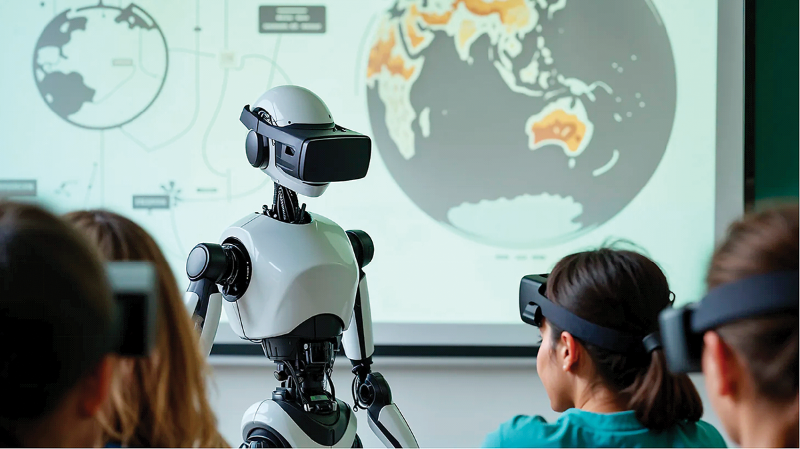
Labor markets are being constantly reshaped by AI, which is altering the nature of many industries and job roles. As a result, the traditional university model - fixed-degree programs delivered through a set number of credits inside lecture halls - can no longer endure in its current form. Vietnamese universities therefore face an urgent need to restructure curricula, shift decisively towards competency-based education, integrate AI, and align more closely with the constantly evolving demands of the country’s labor market.
According to Associate Professor Dao Thi Thu Giang, President of Dai Nam University in Hanoi, AI does not render academic disciplines obsolete; it makes repetitive tasks obsolete and exposes the limitations of legacy training models focused on memorization and formulaic exercises. “The essence of AI, including generative AI, is to augment human capability,” she said. “AI can replace highly procedural operations, but it cannot replace critical thinking, decision-making, creativity, professional ethics, or human connection. The core question is not whether a field of study is still necessary, but how it is taught.”
Keeping pace
Speaking with Vietnam Economic Times / VnEconomy, Associate Professor Nguyen Binh Minh, Director of the Institute of Digital Technology and Economics at the Hanoi University of Science and Technology, also argued that AI will not eliminate knowledge or professions but is making many traditional teaching methods obsolete, particularly those centered on memorization and repetitive tasks that machines can easily perform.
He identified the biggest bottleneck in higher education as institutional inertia. Technology evolves daily, he noted, while many lecturers remain in the comfort zone of traditional methods in which the teacher is the central authority and sole repository of knowledge. As AI and digital transformation challenge that dominance, the instinctive response is often concern or denial rather than acceptance. The greatest challenge, he said, is persuading lecturers to abandon the mindset of being “the one who knows everything” and instead become co-creators of knowledge alongside students and technology.
Education experts broadly agree that AI is restructuring work at the task level, transforming the nature of roles across the economy. Citing International Monetary Fund estimates, Associate Professor Minh said nearly 40 per cent of global jobs, and up to 60 per cent in advanced economies, will be affected by AI. The World Economic Forum forecasts that, by 2030, about 22 per cent of jobs will shift, with 170 million new roles created as 92 million disappear.
“At the Institute of Digital Technology and Economics, we do not treat technology and economics as separate pieces,” he explained. “We view them as an integrated whole under a training philosophy of ‘engineering combined with financial-economic problem-solving.’ This is a distinctive strength of our university, elevated for the digital era.”
On the sidelines of VinFuture Science and Technology Week 2025, Professor Tan Yap Peng, President of VinUni University, said that amid rapid advances in AI, digital transformation, and interdisciplinary science, no university can achieve excellence alone. Through collaboration, shared data, and AI-enabled platforms, the scientific community can produce research and solutions with long-term impact beyond the boundaries of any single institution, or even any single country. In the decade ahead, he continued, success will depend on mastering intellectual resources and data in an era defined by generative AI, the knowledge economy, and rapidly-changing employment models.
Associate Professor Phan Huu Nghi, Deputy Director of the Institute of Banking and Finance at the National Economics University, noted that Vietnam’s planned digital asset and cryptocurrency exchange, which is expected to involve banks, securities firms, and technology companies, will create substantial growth opportunities for digital banking, digital finance, and fintech. His Institute’s program development, he said, has consistently anticipated shifts in Vietnam’s financial market, launching new majors over time, from public finance and securities to advanced finance, high-quality programs, and one of Vietnam’s first fintech training programs.
Universities restructuring curricula
Associate Professor Giang said the central challenge is that changes to the labor market are outpacing the education system’s ability to adapt. University programs can no longer focus solely on transmitting knowledge; they must produce graduates with practical workplace capabilities. Faculty must continually update their own expertise while adapting to rapid technological change. At the same time, today’s students face an expanding array of career options but often lack clear direction and self-guided learning skills.
She outlined three main directions for curriculum reform. First, integrate AI as a foundational competency embedded across disciplines rather than taught separately. Second, shift from knowledge transmission to competency development, especially applied skills, systems thinking, and real-world problem-solving. And third, align training with the fluid demands of the labor market instead of fixed occupational frameworks.
At Dai Nam University, 2026 marks the second year of an accelerated training transformation in response to rapid AI development, with AI being integrated as a learning and working tool for students across all disciplines. “Our goal is not merely to teach students how to use AI tools, but to train individuals capable of mastering their work in a labor market continually reshaped by AI,” she said.
Amid new economic and labor market developments, Associate Professor Nghi told a recent conference on digital assets in the banking and financial system that the Institute of Banking and Finance will continue innovating its curricula, maintaining its current fintech program while adding a digital banking program developed through international partnerships and localized for Vietnam.
The Ministry of Education and Training, meanwhile, has issued a national framework requiring at least 120 credits for undergraduate programs, including compulsory courses such as political economy, physical education, national defense, and philosophy, along with basic graduate standards. Recent regulations also mandate the integration of digital knowledge to ensure students have foundational understanding of digital transformation and technology.
Beyond that framework, universities have autonomy to design programs for each major and specialization, subject to domestic or international quality accreditation. Many institutions, including the National Economics University, are pursuing international accreditation to enhance global integration, often adapting standard foreign curricula to Vietnam’s context while adding institution-specific components.
In terms of content, students must master core disciplinary knowledge while developing technological competence. “Theoretical learning without technological integration cannot meet real-world demands,” Associate Professor Nghi said. “English and digital literacy are no longer advantages but basic requirements. What remains lacking is interdisciplinary capability and the ability to apply knowledge to practical problems, such as finance, risk management, data analysis, basic programming, or using AI as a support tool.”
Professor Peng added that with a talented and highly-motivated student population, Vietnam has an opportunity to leap forward by focusing on AI, green technology, health sciences, and digital transformation, while strengthening public-private partnerships and attracting high-quality talent. “With the right approach, Vietnam can narrow the gap with leading countries and build a modern, flexible higher education model,” he believes.






 Google translate