


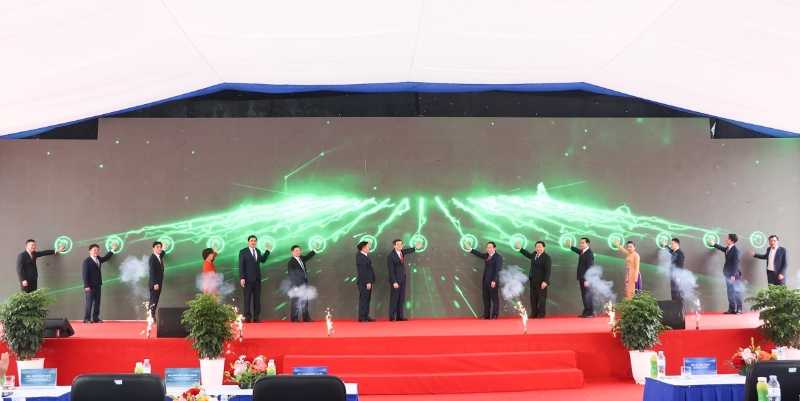
The Nghe An Provincial People’s Committee, in collaboration with a consortium of investors, held a ceremony on May 18 to announce and commence the technical infrastructure construction of the Quynh Lap LNG Thermal Power Plant.
As a key power project under Vietnam’s Power Development Plan VIII (PDP8), the plant represents a total investment of over VND59.37 trillion (approximately $2.25 billion).
The power plant will have a total capacity of 1,500 MW, featuring two combined-cycle gas turbine units. The project is expected to occupy approximately 60 hectares of land and 100 ha of sea surface.
The project is being developed by a consortium comprising PetroVietnam Power Corporation (PV Power), SK Innovation (South Korea), and Nghe An Sugar Limited Liability Company (NASU).
According to the development plan, the plant is scheduled for completion and commissioning between 2026 and 2030. Once operational, it will become a vital LNG gas-to-power hub for the country's North Central region.
The project is identified as a strategic priority for national energy development, directly contributing to the implementation of the Politburo’s Resolution No. 70 on ensuring national energy security.
Furthermore, it serves as a major economic driver within the Nghe An Provincial Master Plan for the 2021–2030 period, with a vision toward 2050, opening new development opportunities for the northern districts of the province.
Speaking at the ceremony, Chairman of the Provincial People’s Committee, Mr. Vo Trong Hai, emphasized that the Quynh Lap LNG Thermal Power Plant will not only provide a stable, modern, and environmentally friendly electricity source for the national grid but also act as a powerful catalyst for the growth of local industry, services, logistics, and seaport infrastructure.




 Google translate