


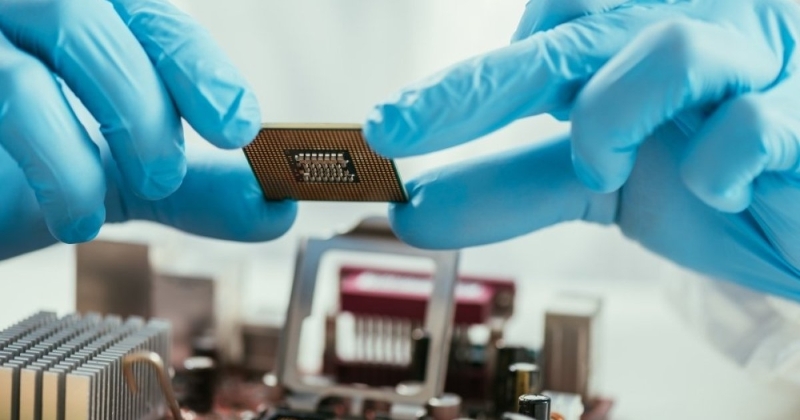
In 2021, at a time when the Covid-19 pandemic had only recently subsided, many economists were predicting that the global semiconductor market could reach, or even exceed, $1 trillion by 2030. In reality, the market already approached $800 billion at the end of 2025 and is projected to continue growing strongly in 2026, potentially nearing or surpassing the $1-trillion threshold. The period from 2026 to 2030 is expected to witness a major leap forward driven by the AI supercycle, pushing the market well beyond $1 trillion and possibly reaching $1.4-1.6 trillion, under the most recent scenarios.
In that context, advanced packaging is no longer a supporting step but has become a core component in scaling and enhancing semiconductor performance. It is increasingly viewed as a strategic opportunity for Vietnam to participate more deeply in the global semiconductor value chain.
AI supercycle
Ms. Nguyen Bich Yen, Honorary President of the Institute of Semiconductors and Advanced Materials at Vietnam National University, Hanoi (VNU), said the growth momentum of the semiconductor industry over the past five years “comes from new technologies”, and this will remain the case for the time being. She estimated that around 50 per cent of revenue growth is driven by AI, about 30 per cent by electric vehicles and intelligent transportation systems, and the remainder by the Internet of Things (IoT), premium consumer electronics, and, potentially, quantum computing in the future. “The demand for high-performance computing and the processing of massive data volumes is taking the entire semiconductor industry forward,” she noted.
A look at the history of the computer market clearly shows how successive waves of technology have created growth cycles for semiconductors. The first wave began in the 1970s, with mainframe computers pioneered by IBM, followed by minicomputers, personal computers, desktop computing, the internet, mobile internet, and big data. That technological evolution laid the foundation for the emergence and development of AI today.
“AI could not exist without the remarkable advances in integrated circuits, especially the rise of data centers with ever-increasing processing capacity,” Ms. Yen said. “The computing power of processors such as GPUs has grown exponentially, increasing up to ten-fold every decade.”
The semiconductor industry’s record growth is now triggering an unprecedented wave of manufacturing investment. According to the latest World Fab Forecast from SEMI, the global semiconductor industry association, 18 new semiconductor fabs (fabrication plants) began construction in 2025 alone, including 15 300mm fabs and three 200mm fabs. Most are expected to come online in 2026 or 2027, bringing the total number of major new or expanded fabs worldwide to more than 100 by the end of next year.
This expansion will require more than 1 million highly-skilled technical workers by 2030, including design engineers, process technicians, and manufacturing operators, Deloitte has warned in recent analyses.
In terms of capital investment, SEMI forecast that global spending on semiconductor manufacturing equipment will reach $133 billion in 2025, $145 billion in 2026, and a record $156 billion in 2027. Meanwhile, McKinsey estimated total global investment in new fabs could reach roughly $1 trillion by 2030.
Such massive capital spending and enormous demand for talent not only confirm the semiconductor industry’s supercycle but also highlight its deep economic spillover effects, from creating millions of jobs and advancing high-tech industries to reshaping global supply chains.
Focal point
The semiconductor industry has steadily miniaturized transistors - the most fundamental component of every electronic chip - over the last half a century. From micrometer-scale dimensions in the 1960s and 1970s, transistor sizes have continued to shrink, in line with Moore’s Law, and are now approaching the 2-nanometer (nm) node, with mass production expected to begin around 2026. At the same time, chip structures have become increasingly complex. The number of metal layers, once limited to just a few, has now expanded to dozens.
However, experts believe that the further transistor scaling progresses, the more sharply costs escalate. Starting at the 45-nm node, the cost of designing a single chip increases exponentially. At the 5-nm node, design costs can exceed $500 million, while at the 3-nm node they often surpass $900 million for high-end designs.
Meanwhile, manufacturing processes have become far more complex, particularly after transistors transitioned from flat 2D structures to 3D FinFET (Fin Field-Effect Transistor) architectures, requiring extremely precise technical control and sophisticated, expensive machinery.
More importantly, transistor scaling does not benefit every component on a chip equally. While logic and memory blocks can fully exploit advanced technologies to improve performance and energy efficiency, analog circuits, radio frequency (RF) components, and input/output (I/O) interfaces gain little benefit from, and may even be less suitable for, the most advanced nodes. Forcing an entire chip to be manufactured using the same cutting-edge process can significantly raise costs without delivering proportional gains.
Because of these cost and technical constraints, the semiconductor industry is gradually shifting from monolithic system-on-chip (SoC) designs to chiplet architectures. Instead of integrating all functional blocks - such as processing, memory, connectivity, and analog components - on a single die manufactured with the same technology, the chiplet approach divides the chip into multiple smaller units.
Each chiplet performs a specific function and can be manufactured using the most appropriate process technology. Processing components can use leading-edge nodes for maximum performance, while I/O or analog functions may use older nodes to reduce costs.
This approach reduces manufacturing risks, optimizes costs, and increases flexibility in product design and upgrades. However, when chips are divided into multiple chiplets, advanced packaging technologies become critically important. These technologies enable chiplets to connect at high speed with low latency, functioning together as a unified system. As a result, advanced packaging is emerging as a strategic segment in the global semiconductor value chain.
Major opportunity for Vietnam
Packaging is no longer simply about protecting chips. According to Mr. Nguyen Bao Anh, CEO of VSAP LAB Vietnam, chip packaging first acts as an “armor layer” protecting the semiconductor die from mechanical impacts, humidity, oxidation, and corrosive environmental factors.
Beyond protection, packaging also functions as a power distribution system. It supplies power to billions of transistors operating simultaneously and ensures energy is delivered stably to each transistor while minimizing losses and voltage drops. This is critically important because even slight power instability can affect the overall performance of the chip.
Experts say that advanced packaging is no longer a supporting step but a core component in scaling and improving semiconductor performance. Innovations in equipment and manufacturing processes play a decisive role in ensuring precision, uniformity, and scalability - all essential requirements for the next generation of semiconductor manufacturing.
“From 2025 onwards, the packaging sector is entering a particularly exciting phase,” Mr. Bao Anh said. “Packaging is no longer just a protective layer for chips but part of system architecture.” He added that major companies and research labs are investing heavily in increasingly sophisticated packaging technologies to boost performance for AI systems and future technologies.
The world, he continued, is entering a period in which packaging technologies will continue to evolve rapidly, and their role in the semiconductor industry will become more important than ever.
Ms. Yen said Vietnam holds significant advantages, from a young workforce capable of learning quickly and adapting to new technologies and strong government support for foundational technology sectors, including semiconductors. Vietnam is also seeing the emergence of domestic companies with ambition and a willingness to invest systematically in technically challenging but strategically valuable industries.
“Advanced semiconductor packaging is becoming a strategic opportunity,” she emphasized. “In the current context, advanced packaging could open a major opportunity for Vietnam to participate more deeply in the global semiconductor value chain.”






 Google translate