


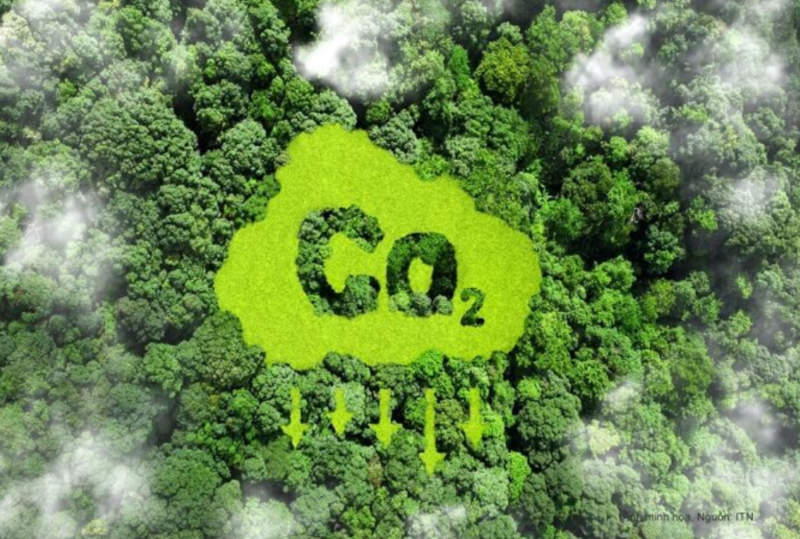
Amid the global race towards net-zero emissions, forests are becoming vast carbon “banks.” Managing by carbon footprint and clearly defining forest carbon rights will create a “green lever” for Vietnam’s forestry economy, improving livelihoods for millions of people involved in forest protection. As the country gradually forms a carbon market, measuring and managing greenhouse gas emissions becomes a critical requirement across many production sectors.
At a recent press conference organized by international non-profit Forest Trends, Dr. Vu Tan Phuong, Director of the Vietnam Forest Certificate Office (VFCO) at the Vietnamese Academy of Forest Sciences, said a “carbon footprint” refers to the total greenhouse gas emissions generated across the entire production and consumption value chain of a product, typically expressed in tons of CO2 equivalent.
These emissions come not only from CO2 but also from other greenhouse gases such as methane, nitrous oxide, and hydrofluorocarbons. CO2 serves as the standard unit for conversion, enabling assessment of energy and resource consumption as well as the environmental efficiency of products and services.
Managing by carbon footprint
Carbon emissions are commonly divided into three scopes: first, direct emissions at production facilities, such as factory operations or agricultural activities; second, indirect emissions from purchased energy sources, primarily electricity; and third, emissions across the entire supply chain, including transportation, distribution, and related activities before products reach consumers.
Vietnam has gradually refined its legal framework to develop a carbon market, notably through Decree No. 119/2025/ND-CP amending and supplementing Decree No. 06/2022/ND-CP on greenhouse gas emissions management and emission quotas, and Decree No. 29/2026/ND-CP establishing a domestic carbon exchange, laying the foundation for carbon credit trading.
Under the domestic carbon market mechanism, companies receive annual emission quotas. Those that exceed permitted levels must purchase carbon credits or invest in technological upgrades to reduce emissions. Current regulations allow companies to use carbon credits to offset up to 30 per cent of excess emissions, with the remainder requiring reductions through technological and management solutions. The mechanism is expected to increase demand for carbon credits, creating opportunities for sectors capable of carbon sequestration, particularly forestry.
Forest carbon credits can be generated through two main pathways: reducing emissions and increasing carbon sequestration capacity. Measures such as limiting deforestation, reducing biomass burning, changing production practices, improving forest quality, and extending harvesting cycles can all generate credits. However, projects must undergo registration and measurement, reporting, and verification (MRV) processes under international standards, with independent validation required for recognition.
Dr. Phuong noted that remote sensing technology and satellite data are playing an increasingly important role in monitoring forest changes and assessing carbon sequestration capacity. Programs such as Landsat provide free data that enhances accuracy and transparency in forest resource management and the development of the carbon credit market.
Example from Gia Lai
According to the Gia Lai Provincial Forest Protection Department, the central highlands province has a natural area of more than 2.15 million ha, including nearly 988,000 ha of forest land - over 692,000 ha of natural forest and more than 295,000 ha of planted forest. On average, each hectare of forest can absorb about 4-6 tons of CO2 a year. At an estimated average of 5 tons per hectare annually, Gia Lai’s forests could absorb nearly 4.9 million tons of CO2 each year.
If converted into carbon credits and traded at a reference price of about $10 a ton, the potential economic value could reach into the tens of millions of dollars annually. This represents significant potential but requires careful, sustainable, and properly regulated exploitation.
Experts believe forest carbon credit trading could generate sustainable revenue for the State budget and forest owners while promoting forest protection and development, improving livelihoods for local communities, particularly ethnic minorities who depend on forests. With its existing potential and coordinated action from authorities, forest carbon credits are expected to become a new growth path for Gia Lai’s forestry sector, protecting “green assets” while creating sustainable socio-economic value.
To develop a national standard framework for forest carbon credits, Vietnam is considering two credit-generation approaches: afforestation and reforestation (ARR) and improved forest management (IFM). Recent studies indicate that IFM applied to existing planted forests, especially extending harvesting cycles, is a feasible short-term approach to increase biomass stocks and stored carbon.
However, implementing this measure faces challenges. Beyond requiring advanced forest management techniques, the model must be applied at sufficient scale while ensuring environmental integrity, economic efficiency, and compatibility with current management conditions. In many localities, planted forests remain fragmented, and decisions on harvesting, replanting, or extending business cycles largely depend on smallholder participation. Building linkage mechanisms and encouraging forest owner participation is therefore becoming a key factor in developing the forest carbon credit market.
Defining forest carbon rights
According to Associate Professor Nguyen Ba Ngai, Vice Chairman of the Vietnam Forest Owners Association (VIFORA), Vietnam holds a major advantage with its diverse forest ecosystems, including more than 10.1 million ha of natural forest and 4.7 million ha of planted forest. Carbon density in forest biomass ranges from 29 to 146 tons per hectare, creating substantial potential for conversion into carbon credits. However, significant challenges remain for Vietnam to become a strong carbon economy.
First is the legal gap. The current Law on Forestry focuses mainly on tangible products such as timber, while carbon is categorized as a forest environmental service rather than an independent asset, complicating the determination of ownership, usage rights, and revenue sharing from carbon credits.
Second is ownership determination. About 87 per cent of Vietnam’s forest area is publicly-owned and managed by the State, while forest owners and local communities directly protect forests and deliver emission reductions. Without clear allocation mechanisms, disputes or risks of double-selling carbon credits could arise. Communities living near forests often receive benefits that do not match their contributions despite their crucial role in protection.
And third is technical complexity and market risk. To gain international recognition, carbon credit projects must undergo rigorous MRV processes under international standards, requiring significant cost and expertise.
To capitalize on opportunities in the green economy, Associate Professor Ngai proposed several strategic solutions. Carbon rights should be legalized as a special type of asset, incorporated into the Law on Forestry and recognized as an intangible asset under the Civil Code to facilitate investment and transfer. Transparent benefit-sharing mechanisms are also needed, allowing the State to delegate or assign benefit rights to forest owners while ensuring most revenue is reinvested in local communities. Establishing a blockchain-based carbon credit registry is seen as a way to prevent fraud and enhance market transparency.
The global trend is to separate carbon rights from land ownership to facilitate commercialization and participation in international green finance markets. For Vietnam, completing the forest carbon rights framework would not only enable the effective use of green resources but also strengthen the country’s position in the global green economy transition.







 Google translate