


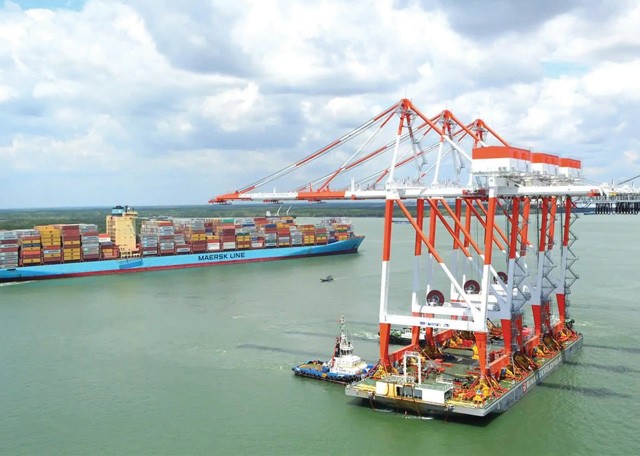
The global economy has operated under an exceptionally high level of uncertainty this year, with cyclical and structural factors combining to create an increasingly complex trading environment.
Despite maintaining solid export growth, Vietnamese goods continue to face significant structural risks amid this volatile environment. To sustain export momentum while managing the risk of a widening trade deficit in the second half of 2026, experts and industry associations have proposed a range of strategic measures for businesses.
Growing pressure on exporters
Conflicts in the Middle East and other international trade flashpoints have extended delivery times while increasing transportation, insurance, warehousing, and storage costs. These pressures are particularly acute for industries that rely heavily on imported materials, including textiles and garments, footwear, wooden products, electronics, mechanical engineering, and machinery manufacturing.
At the same time, new-generation technical barriers continue to expand. Import markets are raising standards related to environmental protection, labor practices, traceability, carbon emissions, social responsibility, food safety, packaging, labeling, and trade remedies.
Mr. Nguyen The Hiep, Deputy Director of the Hanoi Department of Industry and Trade, said Hanoi’s exporters are facing significant challenges as geopolitical tensions and rising logistics costs continue to undermine competitiveness.
Many small and medium-sized enterprises (SMEs), craft village businesses, and OCOP (One commune, One product) enterprises lack the financial and technological resources needed to comply quickly with these new requirements.
Businesses also continue to struggle with internal constraints, including limited access to capital, outdated technology, shortages of personnel familiar with international regulations, and weak capabilities in branding, international marketing, cross-border e-commerce, and negotiations with major overseas buyers.
Pressure is mounting across Vietnam’s major export industries. During the first seven months of 2026, agricultural, forestry, and fisheries exports encountered growing difficulties as major markets tightened technical standards.
Ms. Duong Thi Minh Tue, Vice Chairwoman of the Ho Chi Minh City Handicraft and Wood Industry Association, said that although the wood industry’s traditional export markets have remained relatively stable, recent changes in tariffs, trade defense measures, green standards, and stricter traceability requirements have directly affected Vietnamese wooden product exports.
Trade deficit
According to the National Statistics Office at the Ministry of Finance, Vietnam’s total merchandise trade reached $659.58 billion during the first seven months of 2026, up 28.1 per cent year-on-year. Exports totaled $319.53 billion, an increase of 21.7 per cent, while imports surged 34.8 per cent to $340.05 billion. The faster pace of import growth pushed Vietnam into a trade deficit of $20.52 billion.
Mr. Nguyen Anh Son, Director of the Agency of Foreign Trade at the Ministry of Industry and Trade (MoIT), said restoring balance during the second half of 2026 will be extremely challenging because Vietnam will need to generate an average monthly trade surplus of around $3 billion.
To meet this goal, Vietnam Trade Offices overseas need to strengthen support for industry associations by identifying new markets and providing timely information on trade remedies and technical barriers. Mr. Son also called on the Vietnam Logistics Business Association (VLA) to help reduce logistics costs, noting that banking charges, interest rates, and logistics service fees are consuming much of exporters’ profits.
Alongside traditional export promotion, businesses are also looking to digital channels as a new growth engine. Mr. Bui Trung Kien, Vice Chairman of the Vietnam E-commerce Association (VECOM), said the Association hopes to work with the MoIT to accelerate exports through both B2B and B2C e-commerce. Since 2017, VECOM has developed the Vietnam E-commerce Supporting Alliance (VESA) to connect businesses, digital platforms, and industry experts in helping Vietnamese companies expand internationally. He called on more government agencies, organizations, and business associations to join the network so exporters can benefit from broader support.
He also proposed expanding what he described as “on-site exports” through tourism. By purchasing Vietnamese products while visiting the country, international tourists effectively become ambassadors who introduce those products to overseas markets. He said this model offers SMEs a practical way to reach foreign consumers without requiring significant investment in logistics or export procedures.
He also highlighted overseas Vietnamese communities as an underutilized export channel. Better market intelligence collected by Vietnam Trade Offices abroad, combined with stronger distribution networks, would help connect Vietnamese suppliers with overseas demand.
To support this effort, VECOM is prepared to work with the MoIT to establish a national system for collecting and distributing purchasing inquiries. Import requests gathered by Vietnam Trade Offices could be standardized and matched directly with suitable domestic suppliers through a Vietnamese-developed Request for Quotation (RFQ) platform, improving transparency while converting market information into actual export orders.
Taking greater control
Beyond expanding markets, industry leaders argue Vietnam must also play a larger role in managing international supply chains rather than remaining a passive participant.
Mr. Tran Chi Dung, Standing Committee Member of the Vietnam Logistics Business Association (VLA), noted that nearly 80 per cent of Vietnamese exporters continue to trade under FOB (Free on Board) terms, while around 70 per cent of imports use CIF (Cost, Insurance and Freight) terms.
As a result, decisions regarding shipping routes, carrier selection, and logistics costs remain largely in the hands of foreign companies, leaving Vietnamese businesses vulnerable whenever disruptions occur.
Many small and medium-sized enterprises (SMEs), craft village businesses, and OCOP (One commune, One product) enterprises lack the financial and technological resources needed to comply quickly with these new requirements.
Though the VLA regularly provides market updates, risk warnings, and guidance for its members, Mr. Dung said it often lacks sufficient information to address the root causes of these challenges.
He proposed three priorities. The first is launching “supply chain diplomacy” initiatives through closer cooperation with Vietnam Trade Offices overseas to build detailed supply-and-demand databases. The second is accelerating the development of digital industry platforms through a “Transparent Digital Supply Chain Corridor” capable of verifying products, tracing origins, monitoring shipments, and standardizing high-quality data throughout the supply chain. And the third is enabling Vietnamese businesses to play a more active role in managing global supply networks.
The VLA also proposes developing a Vietnamese-controlled digital platform that integrates trading, transportation, and payment services, with the ambition that transactions conducted through the platform will account for 30 per cent of Vietnam’s total import-export turnover within five years, equivalent to approximately $300 billion.
Mr. Dung added that Vietnam’s logistics companies have historically focused almost exclusively on transportation services. Future policy, he argued, should enable the sector to participate across the entire supply chain by connecting information flows, goods movement, and financial transactions rather than remaining confined to a single stage.



 Google translate