


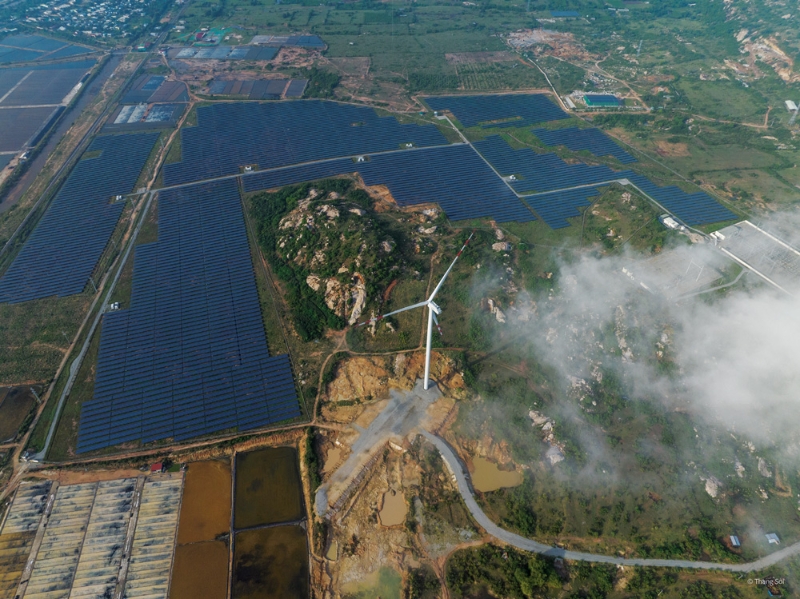
Amid forecasts of continued strong growth in electricity demand in the years to come, at the same time as Vietnam’s power sector accelerates the development of power generation projects it is also stepping up investment in grid infrastructure to enhance transmission capacity, promptly distribute power output, and ensure the safe and stable operation of the system. As demand grows rapidly and the share of renewable energy increases, the role of the grid extends beyond mere “transmission” to become a decisive factor in the system’s ability to absorb and efficiently allocate power across the entire network.
Attracting the private sector
In terms of investment, under the National Power Development Plan for 2021-2030 with a vision to 2050 (PDP8), total investment in power generation and transmission grid development in Vietnam during the 2026-2030 period is estimated at approximately $136.3 billion. Of this, around $118.2 billion is allocated for power generation and $18.1 billion for power transmission grids. With more than 1,000 power transmission grid projects expected to be implemented during this period and total capital demand reaching roughly $18.1 billion, the investment pressure on national grid infrastructure is substantial.
During the thematic session entitled “National grid and regional connections: The way forward in Vietnam’s trajectory towards net-zero,” held within the framework of the recent EU-Vietnam Global Gateway Business and Investment Forum, Mr. Nguyen Manh Cuong from the Planning and Development Division of the Electricity Authority of Vietnam (EAV) at the Ministry of Industry and Trade (MoIT), noted that of the total $18.1 billion required, approximately $12.9 billion is expected to come from the State sector, while around $5.2 billion, equivalent to nearly 30 per cent of total investment, will need to be mobilized from non-State sources. “This clearly demonstrates the increasingly important role of the private sector and foreign investors in the development of transmission grid infrastructure,” he emphasized.
Meanwhile, investment in the transmission grid is still largely undertaken by Vietnam Electricity (EVN) and the National Power Transmission Corporation (EVNNPT), which maintain an almost monopolistic role in the construction and operation of the high-voltage grid. This reality underscores the urgent need to broaden the participation of other economic actors to meet rising capital demands.
This direction is also aligned with Politburo Resolution No. 70-NQ/TW, which encourages private sector participation in energy projects on the basis of fair competition. Accordingly, the MoIT is expediting the institutionalization of these policies in the draft amended Law on Electricity, focusing on improving capital mobilization mechanisms, simplifying investment procedures to shorten project timelines, and developing technical standards for emerging areas such as smart grids and energy storage systems.
Similarly, the orientation set out in Politburo Resolution No. 68-NQ/TW reaffirms the private sector as a key driver of the economy, further emphasizing the need to create more favorable conditions for deeper private sector participation in the power sector. Mr. Cuong said that with these orientations and solutions, the MoIT is making determined efforts to translate major policy directions into reality, while effectively attracting resources from financial institutions and the private sector. “This will contribute to the development of the transmission grid system, which is critical infrastructure with decisive significance for economic growth, energy transition, and sustainable development,” he went on.
From the perspective of international investors, Ms. Cristina Bergomi, Senior Vice President of GE Vernova, suggested that in order to attract private and foreign investment into Vietnam’s national grid infrastructure, the country needs a clear, phased roadmap designed to gradually expand participation from both domestic and international investors.
Specifically, in the initial phase, transmission grid projects should receive strong government support, including guarantee mechanisms or risk-sharing frameworks, to build early market confidence. This is particularly important in the transmission sector, which is characterized by large capital requirements, long payback periods, and high risk levels. Once confidence is established through pioneering projects, the market will become progressively more attractive to private investors and international developers.
Building on that foundation, in subsequent phases, Vietnam can scale up investment attraction, promote deeper participation from the private sector and foreign investors, and encourage diverse partnership models across the value chain. “In particular, the successful implementation of pilot projects will serve as a ‘proof of concept,’ helping to reduce perceived risks and create a spillover effect for future projects,” Ms. Bergomi noted.
In addition, to enhance the likelihood of success, investors should be involved from the early stages of projects, not only in financing but also in design, technical studies, and operational structuring. Early engagement allows stakeholders to optimize implementation plans, better manage risks, and ensure long-term feasibility. This is also a key factor in transforming the power grid, traditionally dominated by State-owned enterprises, into a more attractive destination for both domestic and international investment capital.
Three core pillars.
Beyond boosting investment, experts also emphasize that improving the quality and operational capacity of Vietnam’s power grid remains a critical priority. Mr. Francesco Comito, Area Manager in South Asia and Far East at CESI, highlighted that the modernization of Vietnam’s transmission system should be built on three main pillars: digitalization, enhanced flexibility, and transformation of the operational model. On this basis, the power system will gradually transition from a traditional alternating current (AC) structure to a hybrid model, in which high-voltage direct current (HVDC) technology serves as the “backbone,” complementing the existing grid.
Under the digitalization pillar, Vietnam should prioritize the development of core technologies to strengthen system monitoring and dispatch capabilities. In this context, supervisory control and data acquisition (SCADA) systems and energy management systems (EMS) are often described as the “brain” of the grid, enabling real-time monitoring and operation, while substation automation based on International Electrotechnical Commission (IEC) 61850 standards can significantly reduce the frequency and duration of outages.
At the same time, the deployment of wide-area monitoring systems will help track the dynamics of the entire grid, laying the foundation for a shift from reactive to predictive operations. According to Mr. Comito, though notable progress has been made, digitalization efforts still need to be accelerated and implemented more synchronously to establish a truly smart grid.
In terms of flexibility, as the share of renewable energy continues to rise, enhancing the flexibility of the transmission system becomes essential. Unlike conventional power sources, wind and solar energy are inherently variable, leading to continuous fluctuations in supply and demand. Without sufficient system flexibility, localized oversupply or grid congestion may occur, resulting in curtailment and reduced investment efficiency.
Regarding the third pillar - the transformation of the transmission model - the role of HVDC systems is particularly emphasized. Given Vietnam’s elongated north-south geography, where renewable energy resources are concentrated mainly in the central and southern regions while major demand centers are located in the north, the power system faces a structural imbalance. In this context, HVDC enables long-distance power transmission with lower losses while enhancing overall system stability.
Looking ahead, the development and mastery of HVDC systems will also provide a foundation for Vietnam to participate more deeply in the ASEAN regional power grid. “Overall, current priorities should not be limited to expanding power grid infrastructure in Vietnam, but more importantly, to building a smarter, more flexible, and more sustainable power system,” Mr. Comito concluded.






 Google translate