


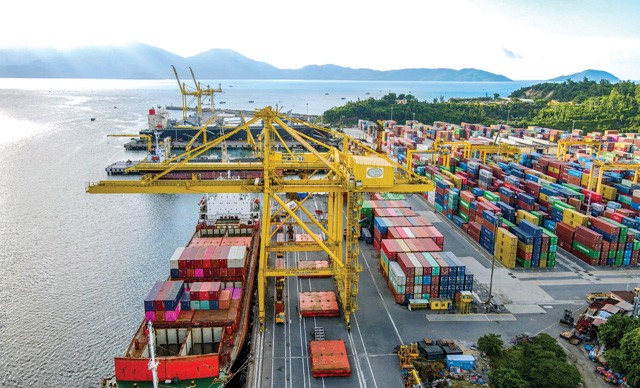
The Ministry of Industry and Trade is finalizing a draft Strategy for Goods Import and Export to 2030, with a vision to 2045, which updates the global context and domestic production capacity to create a comprehensive and feasible framework suited to the new environment, backed by a clear action plan to help achieve the country’s goal of double-digit growth in the years to come. This marks a significant departure from the existing Strategy for Goods Import and Export to 2030, approved by the Prime Minister under Decision No. 493/QD-TTg dated April 19, 2022.
Strategic vision
At a recent meeting on the draft Strategy, Deputy Minister of Industry and Trade Nguyen Sinh Nhat Tan emphasized that it cannot stand alone but must be closely connected with other component strategies, including domestic market development, the development of specific product groups, and strategies for developing economic actors and new growth drivers.
A key legal foundation for the new Strategy is Conclusion No. 18-KL/TW dated April 2, 2026, issued by the second plenum of the 14th Party Central Committee. The Conclusion sets out requirements for the 2026-2030 socio-economic development plan, national financial plan, and medium-term public investment plan, all of which are linked to the goal of achieving double-digit growth.
According to Mr. Nguyen Anh Son, Director of the Agency for Foreign Trade at the Ministry of Industry and Trade, the biggest change is the adjustment to the targeted growth rate. Under the current Strategy, merchandise exports are projected to grow by just 6-7 per cent annually during 2021-2030. Under the new direction set out in Conclusion No. 18-KL/TW, that rate must rise to 15-16 per cent annually. Achieving this target will require the draft Strategy to introduce new breakthrough solutions and tasks focused on significantly strengthening production capacity, unlocking transport capacity, and expanding import-export markets.
The higher growth target also requires a more realistic approach to the trade balance. Rather than focusing primarily on trade promotion or market regulation, the draft Strategy must address the issue at its roots: production and investment. Rebalancing trade with major partners will require Vietnam to strengthen its ability to secure domestic supplies while diversifying its portfolio of higher value-added products.
This has become increasingly urgent as the global environment grows more complex, with new international trade arrangements and increasingly stringent rules and regulations. Vietnam needs to reposition itself in global value chains, moving beyond its role as an assembly hub to become a critical link capable of responding to import-export security risks and challenges arising from new technical barriers.
Four principles
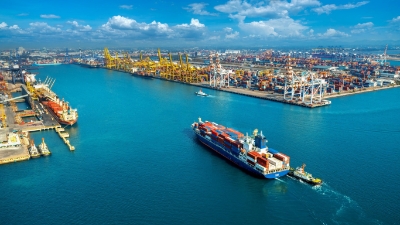
Highlighting the need to renew the growth model in the draft Strategy, Deputy Minister Tan said it must maximize advantages from different sources of resources, including the marine economy and the most advanced economic models in the world. The interaction and integration of these factors will be key to ensuring the Strategy is both practical and feasible.
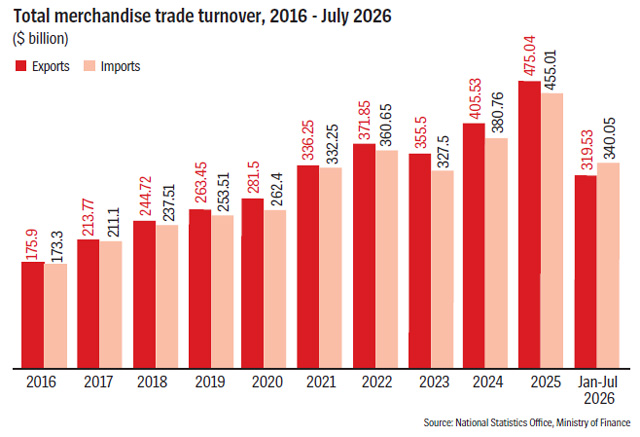
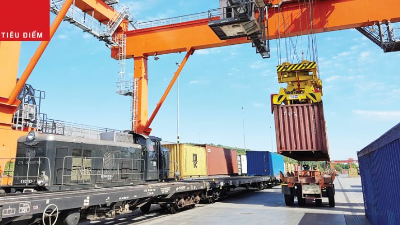
Another important focus is achieving “dynamic balance” in the market, ensuring greater harmony between imports and exports. Under the new approach, imports should not merely serve consumption but also directly support export-oriented production. Supporting tools, including logistics systems, trade promotion and, in particular, domestic and international institutions through free trade agreement (FTA) negotiations, must operate in a coordinated manner. Connecting supply chains from raw materials and production through circulation and ultimately to exports will create a sustainable trade ecosystem for businesses.
The draft Strategy sets out four core principles. First, development should focus on depth, with higher value-added, productivity, and competitiveness. Second, sustainable development should be linked to greater strategic autonomy. Third, development should be coordinated with production and market development. Fourth, State management of import-export activities should be modernized, shifting toward a development-enabling approach.
These principles are translated into three groups of objectives covering scale, quality, and markets, alongside nine groups of key solutions and tasks. Notably, the strategy moves away from the traditional three-pillar model of production, markets and export organization toward solutions aimed directly at addressing existing constraints.
The nine groups cover institutional reform and stronger State management of import-export activities; development and management of export and import markets; development of production, science and technology, and innovation to create high-quality export supplies; management and control of imports to meet domestic production needs while moving toward a healthy and balanced trade position; support for domestic businesses, small and medium-sized enterprises (SMEs), and leading companies in production and exports; export development linked to the green economy, circular economy, and environmental, social, and governance (ESG) compliance; development of logistics services and cross-border e-commerce; development of import-export activities through regional and local links; and reform of industry associations to strengthen their role.
Turning strategy into action
Contributing to the draft Strategy, experts emphasized the need for a shift in thinking, with market direction guiding product development; brand development for overseas markets closely linked to the domestic market; clear growth targets based on both scale and value; and specific industry-market matrices to optimize policymaking and management.
A clear distinction between imports of production inputs and imports that substitute for domestically-produced goods is of particular importance. This would help protect domestic production while maintaining the openness of the economy. Amid a global wave of trade-defense measures, an early-warning system for trade risks should also be prioritized to protect businesses.
At the same time, support should be provided to SMEs seeking to join global supply chains, while priority products should be classified according to green standards to meet the growing demand for sustainable consumption.
Emphasizing that the new Strategy must serve as a “lever” for achieving double-digit growth, Deputy Minister Tan said solutions must not stop at policy documents but must be translated into concrete action, with coordinated participation from localities and relevant stakeholders. To date, the integration of input from eleven ministries and sectors and 27 cities and provinces has demonstrated the broad interest of the political system in the strategy. Under the current timeline, once the draft is finalized, it will undergo broader consultation, with the aim of completing the strategy within this year.





 Google translate