


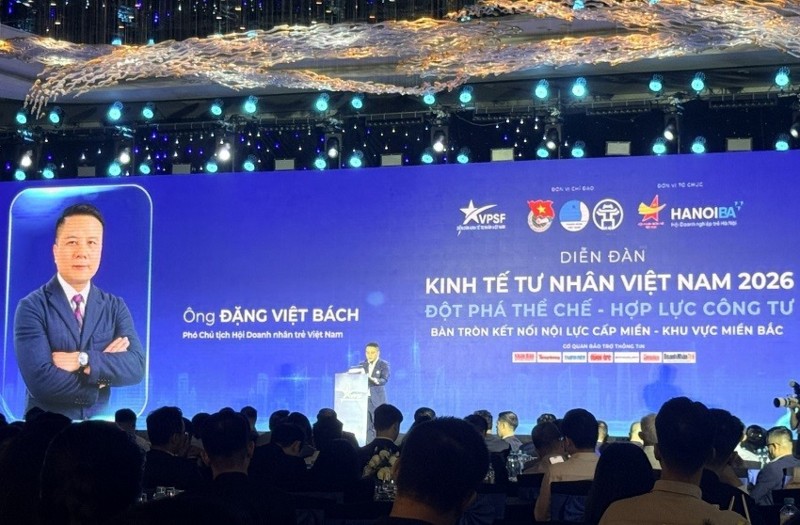
Organized on October 2 in Hanoi by the Vietnam Young Entrepreneurs Association under the framework of the Vietnam Private Economic Forum 2026, the Northern Regional Private Economic Forum centered on the theme “Regional Linkages - Creating Drivers for Double-Digit Growth.”
Delivering the opening address, Mr. Dang Viet Bach, Vice President of the Vietnam Young Entrepreneurs Association, noted that Northern Vietnam’s untapped growth potential lies in transforming individual provincial advantages into a unified economic space, shared value chains, and an integrated market.
“Double-digit growth cannot be achieved by simply adding together the growth rates of individual localities,” he said. “It must be generated through regional linkages and synergistic advantages. The effectiveness of regional integration must be measured by actual freight flows, reduced logistics costs, foreign direct investment (FDI) spillovers, and the deep integration of domestic firms into global supply chains.”
Differentiating real growth from artificial expansion
Offering a microeconomic perspective, Mr. Nguyen Xuan Phu, Chairman of Sunhouse Group, urged policymakers and business leaders to distinguish between “real growth” and “artificial expansion” when assessing economic health.
He argued that national economic strength should not be evaluated solely through aggregate GDP figures, but through underlying growth quality, labor productivity improvements, and cost reductions for businesses and citizens.
While massive infrastructure spending serves as a powerful growth driver, it also places acute pressure on capital, labor, and material inputs - particularly for small and medium-sized enterprises (SMEs).
“Vietnam benefits from numerous free trade agreements, labor cost advantages, and attractive investment incentives,” Mr. Phu noted. “However, recent export surges have been overwhelmingly driven by the FDI sector, while domestic enterprise growth remains constrained. Vietnamese businesses must urgently build internal capacity, particularly in information sharing, supply chain alignment, productivity, and cost control.”
He warned that excessive fragmentation and reluctance to share supply chain information leave domestic firms vulnerable to market disruptions, whereas specialized division of labor enables companies to share risks and preserve order volumes.
High logistics costs remain a core bottleneck
Addressing logistics operational realities, Mr. Tran Dang Nam, President of the Hanoi Young Entrepreneurs Association and Chairman of Dolgroup, identified logistics overheads as a major impediment to national competitiveness.
Vietnam’s logistics costs currently account for 16 to 18 percent of GDP and total import-export turnover, significantly higher than the global average of 10 to 12 percent and well above advanced economies like Singapore, where costs remain below 10 percent.
“High logistics costs serve as a direct bottleneck to growth and investment attraction, especially as global capital shifts toward high-tech and high-value-added sectors,” Mr. Nam said. “Beyond transportation, logistics has evolved into full end-to-end supply chain management aimed at optimizing resources, mitigating compliance burdens, and enhancing regional competitiveness.”
Adding an analytical framework, Dr. Can Van Luc, Chief Economist at BIDV, stated that while market opportunities currently outweigh challenges, domestic enterprises must proactively enhance their adaptive capacity.
Dr. Luc advised Vietnamese businesses to focus on critical operational parameters, including energy availability, interest rates, foreign exchange fluctuations, regulatory changes, and workforce development.
He highlighted artificial intelligence (AI) as a transformative tool enabling enterprises to quickly process legal updates, streamline administrative compliance, and adjust business models in a fast-changing market environment.







 Google translate