


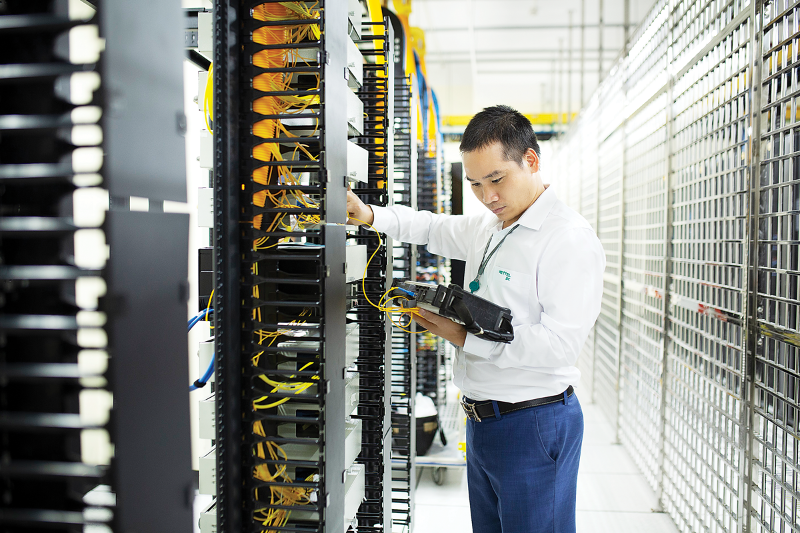
Cost competitiveness serves as a major advantage in terms of data center construction. According to 2026 research from Cushman & Wakefield, average data center construction costs in Vietnam stand at approximately $7.2 million per megawatt (MW), significantly lower than regional peers such as Malaysia ($9.6 million/MW) and Thailand ($8.8 million/MW). Coupled with a moderate construction cost inflation rate of 3.8 percent, Vietnam demonstrates long-term cost efficiency for infrastructure development.
Mr. Pritesh Swamy, Head of Data Centre Research & Advisory, Asia Pacific, Cushman & Wakefield, noted: “As investors seek alternatives to expand beyond markets under pressure regarding land, power, and regulations, Vietnam is emerging as an attractive market.”
However, Mr. Swamy cautioned that Vietnam should not assume it can remain immune to the challenges slowing down data center construction in other markets. “Vietnam is not yet facing severe power shortages like more developed markets, mainly because the scale of ongoing projects remains smaller,” he said.
The opportunity, therefore, lies not only in Vietnam having more available capacity today, but in having the window of time to synchronize power infrastructure, land banks, licensing procedures, and connectivity.
“If supporting infrastructure can keep pace with demand, Vietnam has the potential to become one of Southeast Asia’s next-generation AI infrastructure hubs,” Mr. Swamy stated, emphasizing that high-value, tech-intensive projects are no longer decided primarily by cost, but by infrastructure readiness.
Where data center projects previously prioritized connectivity hubs, Cushman & Wakefield observations across Asia-Pacific indicate that power availability and grid connection speed have become primary criteria for international operators.
“Having land alone is no longer enough. Investors will evaluate locations based on power supply and stability, licensing speed, subsea fiber optic infrastructure, and the consistency of the regulatory environment for long-term foreign investment,” he said.
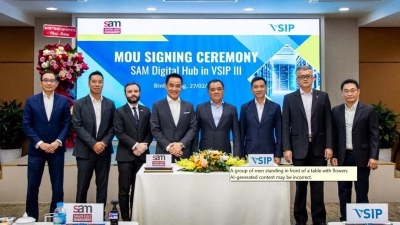
These insights align with perspectives from Mr. Louis Nguyen, Chairman and CEO of Saigon Asset Management (SAM), who is actively developing local data center projects and advising international investors. Beyond real estate, he emphasized four critical viability factors: regulatory framework, power supply, international network connectivity, and actual enterprise demand.
Data governance regulations carry substantial weight in long-term investment commitments. In August, AmCham Vietnam submitted detailed feedback to the Ministry of Public Security regarding Draft Article 32 of the Data Security Law.
AmCham highlighted concerns that while the existing Data Law requires prior approval from the Ministry of Public Security primarily for core data transfers overseas, and a notification mechanism is applicable to such transfer of important data, Draft Article 32 mandates written approval from the ministry for both data transfers. Additionally, it introduces overseas recipient verification, data security impact assessments, and post-transfer monitoring obligations, leading AmCham to recommend removing Article 32 to avoid regulatory overlap.
Mr. Nguyen stressed that these issues must be addressed so that operations in Vietnam harmonize with global cloud architecture, which does not operate as isolated national islands. Instead, data, backups, cybersecurity systems, software, and computational workloads are processed concurrently across interconnected data centers in multiple countries. While major global data center operators are evaluating Vietnam, committing capital to large-scale projects requires operational certainty regarding how data is stored, processed, backed up, and transferred across global networks.
Rather than relaxing security standards, he argued that data safety must remain mandatory, but “the regulatory framework needs to be sufficiently clear, predictable, and compatible with how international cloud systems and data centers operate.”
Similarly, AmCham recommended that Vietnam recognize widely adopted international certifications - such as ISO 27001, SOC 2 Type II, ISO 27017, and Uptime Institute Tier III/IV - instead of requiring duplicate domestic certifications, thereby reducing deployment time and costs while maintaining robust security standards.
Power requirements present another critical operational barrier. AI and HPC data centers consume vastly higher power densities than traditional facilities.
“Investors will need to determine how much power can be supplied to their project, whether transmission and grid interconnection systems are ready or require upgrades, how long connection will take, the degree of power redundancy, and through what mechanisms they can access renewable energy,” Mr. Nguyen pointed out.
Because AI computational power demands expand rapidly over time, international investors increasingly favor sites offering abundant, stable power with scalable capacity, even if located farther from major urban centers.
Mr. Nguyen recommended adopting a phased development model. For instance, a 100 MW or 200 MW data center park can be master-planned for the long term, with Phase 1 deployed based on available grid capacity and committed tenant demand, followed by subsequent phases as power supply and usage grow.
“I am not concerned about whether demand for computing capacity will grow in the long term. AI and digital economy requirements are clear drivers. The key concern is how to ensure a sufficiently large portion of that demand is actually placed and operated in Vietnam,” he said.
However, he cautioned that Vietnam should not engage in a simple race over megawatt numbers, emphasizing that “Vietnam needs to compete on the”'quality of megawatts” rather than just the quantity of megawatts. Announcing a project worth hundreds of millions or billions of dollars is relatively easy, but bringing a data center into effective operation is far more difficult.”






 Google translate