


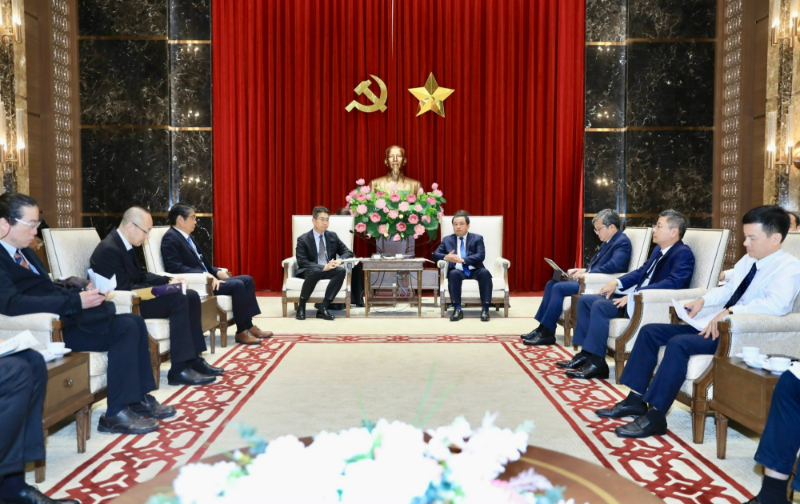
Politburo member, Secretary of the Hanoi Party Committee and Head of Hanoi's National Assembly Delegation Tran Duc Thang had a meeting with Mr. Uno Yoshimasa, Special Advisor to the Japanese Prime Minister.
Japanese Ambassador to Vietnam H.E. Ito Naoki attended the meeting.
At the meeting, Mr. Thang affirmed that Japan and its localities have always been Hanoi's particularly important partners. He noted that the capital city has received valuable support from Japan for its development process, from infrastructure construction to healthcare and education, with many projects leaving a strong imprint.
According to Mr. Thang, Hanoi is entering a new stage of development with higher requirements for both quality and growth pace. In this context, further strengthening cooperation with experienced and reputable partners such as Japan is essential.
Mr. Uno Yoshimasa, for his part, praised the Vietnamese Government’s recent reform efforts, particularly in simplifying administrative procedures and improving the investment climate, thereby facilitating international cooperation.
Recalling a message delivered by Japanese Prime Minister Takaichi Sanae during her recent visit to Vietnam, Mr. Uno Yoshimasa affirmed that Japan wishes to further strengthen bilateral relations, expand cooperation across various fields, and expressed confidence that Vietnam–Japan ties will continue to develop in a substantive and effective manner, contributing positively to the region and the world.
Notably, the Japanese Government expressed its desire, together with the Japanese business community, to participate in Hanoi’s long-term development orientation and 100-year vision, the guest said.
The two sides also held in-depth discussions on Hanoi's Metro Line No. 2 project - an iconic project in bilateral cooperation between Japan and Vietnam, with an expectation of accelerating progress, ensuring effective implementation, and bringing the project into operation soon.
Under the capital’s master plan with a 100-year vision, Hanoi aims to develop 18 urban railway lines with a total length of around 1,200 km, targeting completion within 10–15 years. The city has emphasized the need for comprehensive technology transfer, from manufacturing and operation to maintenance, in order to enhance the long-term self-reliance of Vietnamese enterprises.
Highlighting the importance of the Metro Line No. 2 project, Mr. Thang expressed confidence that once operational, the project will clearly reflect Japan’s presence in Hanoi in particular and Vietnam as a whole. He also called on the Japanese side to strengthen coordination with the Hanoi People’s Committee to address obstacles and challenges during the implementation of the project.
Mr. Uno Yoshimasa noted that Japan has implemented many large-scale infrastructure projects worldwide, including in India, and is fully capable of transferring technology effectively to Vietnam. He affirmed that upon completion of the Metro Line No. 2 project, Japan stands ready to continue participating in Hanoi’s future railway projects.
In addition, both sides exchanged views on several issues of mutual interest, including the North Hanoi smart city project and plans for developing low-emission zones. Mr. Thang affirmed that Hanoi will create the most favorable conditions for Japanese enterprises to invest in such projects and plans.
 Google translate