


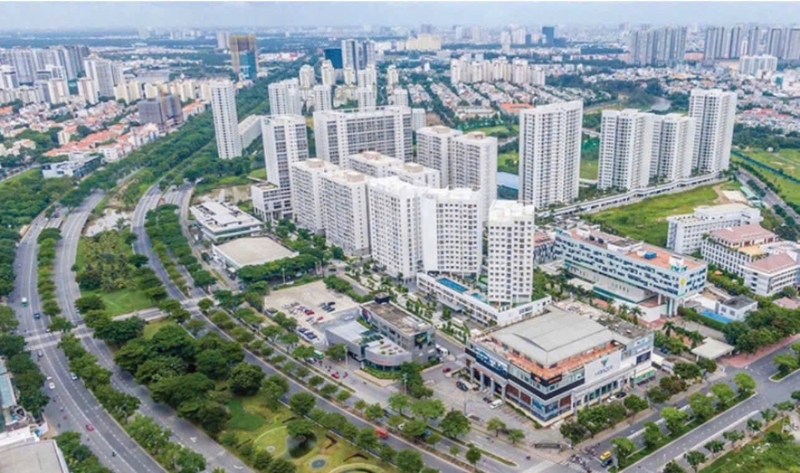
Vietnam’s residential real estate market is expected to see positive shifts in the second quarter of 2026, with new supply increasing significantly compared to the beginning of the year. This trend emerges amid forecasts of a more stable macroeconomy, even as policy management remains cautious.
Ms. Nguyen Thi Kim Thoa, Business and Product Development Director at Dat Xanh Services, provided this assessment in a recently released report by the Dat Xanh Services Economic - Finance - Real Estate Research Institute (DXS-FERI), which analyzes the market performance of Q1/2026 and the outlook for Q2/2026.
She noted that the specific level of growth and absorption will depend on various factors, resulting in three potential scenarios.
In the "ideal scenario," the market would experience strong growth with supply increasing by 40% to 50% and selling prices rising by 10% to 15%. This outlook assumes floating interest rates remain between 9% and 11% and the absorption rate reaches 50% to 60%. However, this outcome is heavily contingent on policy easing, the expansion of credit quotas for real estate, and the simultaneous improvement of multiple fundamental economic factors.
The "expected scenario" projects a more controlled pace of growth. In this case, supply is forecast to rise by 30% to 40% while selling prices increase by a modest 2% to 5%. Floating interest rates would likely hover between 10% and 12%, with an absorption rate of 30% to 40%.
Conversely, the "challenging scenario" assumes rising capital costs and continued tight monetary policy. Under these conditions, supply would only grow by 20% to 30%, while selling prices remain flat or decrease slightly. With floating interest rates potentially reaching 12% to 14%, the absorption rate would likely stay below 20%.
According to experts from DXS-FERI, if the Government and the State Bank of Vietnam continue to strictly regulate the sector through credit tightening and high mortgage rates, the market is likely to follow the challenging scenario—a trend already evident in the first quarter of 2026. In this context, the residential real estate market in 2026 is not expected to return to a period of "hot" growth. Instead, it will operate more selectively, reflecting a market that is currently transitioning into a new cycle.





 Google translate