


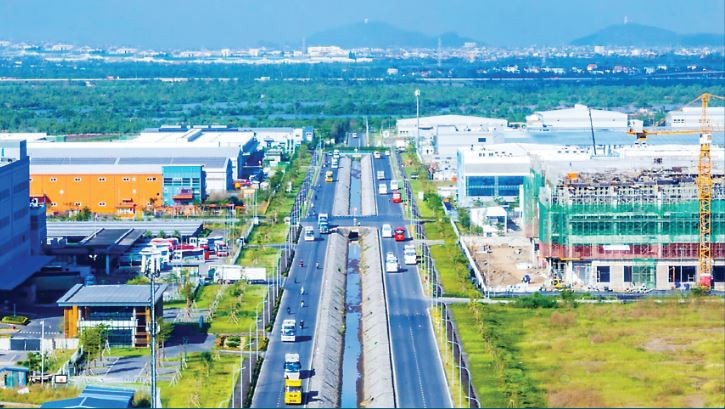
After nearly four decades of economic reform, industrial parks (IPs) have become a cornerstone of Vietnam’s industrialization process, attracting FDI, expanding manufacturing and exports, creating new growth poles, and generating millions of jobs. The country is pursuing double-digit annual economic growth in the years to come, with a focus on shifting from expansion alone to a development model driven by productivity, science and technology, innovation, and high-quality human capital. This requires the country’s IPs to evolve beyond conventional manufacturing hubs into platforms capable of attracting higher-quality investment and supporting the next phase of economic growth.
Given that, the Vietnam Industrial Park Summit 2026 was held in the northern port city of Hai Phong on July 10, endorsed by the Central Commission for Policy and Strategy and organized by the Vietnam National Real Estate Association (VNREA) in coordination with relevant agencies. Policymakers, local authorities, and businesses in attendance agreed that developing green IPs is no longer optional but an essential prerequisite for maintaining Vietnam’s investment appeal, increasing industrial value-added, and achieving sustainable growth.
Changing landscape
According to Mr. Nguyen Anh Duong, Head of General Research and International Integration at the Institute for Policy and Strategy Studies (IPSS) at the Central Commission for Policy and Strategy, the global economy is expected to continue recovering during 2025-2027 but will remain vulnerable to geopolitical competition, trade and investment volatility, and macro-economic risks. Meanwhile, digital transformation, the green transition, the circular economy, and the effective use of free trade agreements are becoming key determinants of national competitiveness in attracting investment.
Mr. Duong noted that global GDP growth is projected to have reached around 2.9 per cent in 2025, will slow to 2.5 per cent in 2026, and then recover to 2.8 per cent in 2027, while global trade growth is also expected to moderate. Against this backdrop, Vietnam aims to sustain double-digit annual economic growth during 2026-2030 while advancing industrial modernization and strengthening economic self-reliance.
As a result, IPs can no longer focus on merely providing manufacturing space. Mr. Duong argued that they should evolve into modern industrial ecosystems that enable businesses to embrace digital and green transformation, strengthen regional links, enhance investment attraction, and contribute to greater economic resilience.
Associate Professor Le Trung Thanh, Full-Time Member of the National Assembly's Committee on Science, Technology and Environment, observed that 10 to 20 years ago IP competitiveness was largely determined by location, land rental costs, and labor availability, while investors today increasingly prioritize science and technology, innovation, digital transformation, and sustainable development.
In particular, the implementation of Politburo Resolution No. 57-NQ/TW on breakthroughs in science and technology, innovation, and national digital transformation is creating entirely new requirements for IP development, which must now provide not only integrated physical infrastructure but also robust digital infrastructure, energy-efficient systems, low-carbon operations, supply chain connectivity, and innovation capabilities.
From an international perspective, Ms. Sibylle Bachmann, Chargé d’Affaires a.i at the Embassy of Switzerland in Vietnam, noted that investors worldwide are increasingly selecting locations based not only on costs and logistics but also on renewable energy availability, carbon performance, circular economy solutions, and environmental, social, and governance (ESG) standards. “The IPs of the future will no longer simply provide land and infrastructure,” she said. “They must become platforms for innovation, resource efficiency, low-carbon growth, and industrial collaboration.”
Mr. Koen Soenens, CSM Director at DEEP C Industrial Zones, said investors continue to evaluate traditional factors such as labor availability, tax incentives, land supply, and infrastructure when selecting locations. However, when committing hundreds of millions of dollars to factories expected to operate for 20 to 50 years, their greatest concern is whether the IP can serve as a reliable long-term partner.
Building better IPs
Meeting these new expectations requires more than planning and infrastructure investment. It also demands institutional reforms that move ahead of market developments. Speaking at the Summit, Mr. Duong said policies need to be updated to facilitate the formation, efficient operation, and long-term adaptability of new IP models in line with evolving industrial production and investment trends.
One important direction, he noted, is the diversification of IP models. Alongside conventional IPs, Vietnam is also promoting eco-IPs, specialized IPs, high-tech IPs, and integrated industrial-urban-service zones to meet increasingly diverse business needs while supporting green and digital transformation. These efforts are being accompanied by policies encouraging circular economy practices, more efficient resource use, stronger regional connectivity, and closer integration between IPs and logistics, urban areas, and service infrastructure.
Mr. Duong added that institutional reforms should go beyond expanding IP models and create favorable conditions for businesses to invest in next-generation infrastructure, including digital infrastructure, energy systems, and solutions supporting green transition and innovation. At the same time, Vietnam should continue decentralizing authority and strengthening coordination between central and local governments to shorten project implementation timelines and improve investment efficiency.
As IP models evolve, investment attraction strategies must also change accordingly. Rather than focusing primarily on increasing project numbers or scale, priority should be given to attracting investments with advanced technologies, strong innovation capacity, efficient resource use, and meaningful spillover effects for domestic enterprises.
This direction is also reflected in Politburo Resolution No. 10-NQ/TW on the development of the foreign-invested sector, issued shortly after the Summit. The Resolution emphasizes the selective attraction of high-tech, environmentally-friendly projects with modern governance while strengthening links between FDI enterprises and domestic enterprises, promoting technology transfer, developing high-quality human resources, and enhancing Vietnam’s position in global value chains.
From policy direction to implementation
The transition toward new IP models is already moving beyond policy discussions and being translated into planning and implementation in several localities.
Ms. Nguyen Thi Bich Dung, Deputy Head of the Hai Phong Economic Zone Management Board, said that following the city’s administrative expansion, authorities see the restructuring of development space as an opportunity to build a more integrated IP system rather than continuing the fragmented development approach of the past. Under this strategy, IPs are planned in close connection with the city’s seaport network, logistics system, urban development, and transportation infrastructure to create highly-integrated production and supply chains.
She added that alongside reviewing and integrating land use, construction, and transportation planning following the merger, the city is also developing shared technical infrastructure across IPs, including water supply, wastewater treatment, and energy systems. The objective is to reduce investment costs, improve operational efficiency, and better prepare IPs for future development requirements.
Another priority highlighted by the Hai Phong Economic Zone Management Board is the selective attraction of investment projects in sectors such as semiconductors, precision engineering, biotechnology, and other industries that make efficient use of land while generating low emissions. At the same time, the city is implementing a roadmap to upgrade existing IPs into eco-IPs, promote circular economy practices, and expand the use of renewable energy in manufacturing.
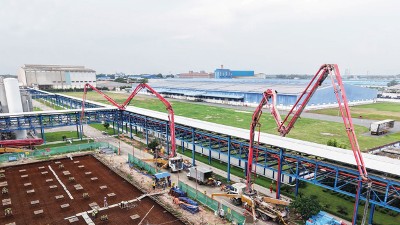
At DEEP C Industrial Zones, Mr. Soenens said that many facilities once regarded as supporting infrastructure are now becoming integral components of IP development. These include renewable energy systems, water reuse, industrial symbiosis, shared logistics, supplier network development, and workforce training.
These components, he continued, must be incorporated from the earliest planning and investment stages to create manufacturing environments capable of meeting the increasingly demanding requirements of international investors. This reflects a broader shift in IP development, which is no longer simply about building physical infrastructure but requires a more integrated approach that addresses the evolving needs of both businesses and industrial development.
Experience from Hai Phong and DEEP C demonstrates that, alongside institutional reform, the transformation of Vietnam’s IPs is already taking shape through integrated spatial planning, infrastructure investment, and the development of comprehensive business ecosystems. Together, these represent the first tangible steps toward realizing the country’s vision for IPs in the next stage of economic development.




 Google translate