


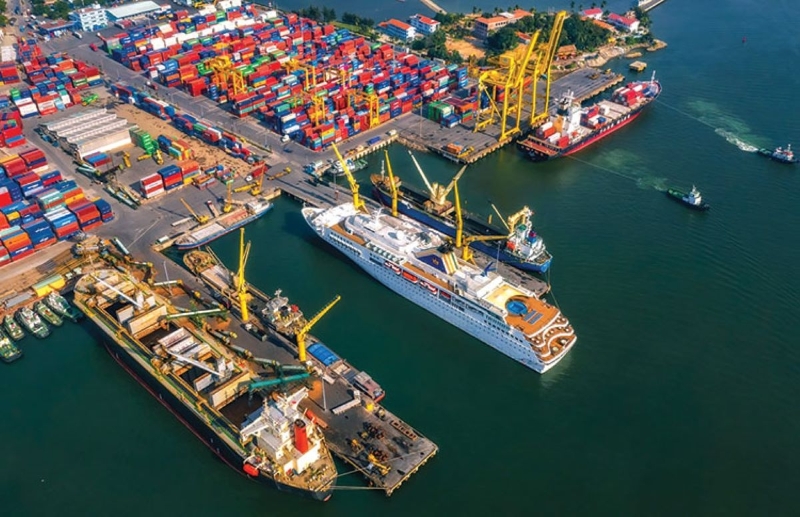
Recent conflicts in the Middle East are beginning to generate significant impacts on international transport and logistics networks. According to a compilation of information prepared by the Private Economic Development Research Board (Board IV), escalating tensions between the US and Iran following large-scale airstrikes on February 28 by the former have placed Asia-Europe cargo routes at risk of new disruptions.
Strategic routes under threat
The epicenter of these disruptions lies in the Strait of Hormuz, a maritime corridor widely regarded as the “chokepoint” of the global energy market. Data from the US Energy Information Administration (EIA) shows that around 20 per cent of the world’s seaborne oil passes through the Strait each day.
The compilation indicates that Iran has issued security warnings in the area, prompting international shipping lines to exercise greater caution when operating through the Gulf. Though the Strait of Hormuz has not been fully closed, rising security risks have already led some carriers to adjust routes or temporarily suspend operations in the region.
Beyond Hormuz, shipping routes through the Red Sea and the Suez Canal - key arteries linking Asian manufacturing centers with European markets - are also being affected by geopolitical instability.
According to analysis by the Viet Dragon Securities Corporation (VDSC), if security conditions continue to deteriorate, many container vessels may be forced to divert via the Cape of Good Hope at the southern tip of Africa rather than transit through the Suez Canal.
Several major container shipping companies, including CMA CGM, Maersk, and Hapag-Lloyd, have announced the imposition of war-risk surcharges of up to $1,500 per TEU for standard cargo and $3,500 per TEU for refrigerated or special cargo, while adjusting routes via the Cape to avoid conflict zones. Meanwhile, the Mediterranean Shipping Company (MSC) has temporarily suspended bookings for shipments to the Middle East.
Such route adjustments could extend transit times between Asia and Europe by an additional 10-14 days while increasing vessel operating costs and fuel consumption. At the same time, war-risk insurance premiums for vessels operating in the Gulf are being reassessed and raised by international insurers.
The ripple effects of these developments are already becoming visible in global shipping activities.
Mr. Luong Trung Thanh, CEO of Sunway Logistics, said the impact of Middle East tensions extends beyond routes directly serving the region. Intercontinental shipping typically operates under a hub-and-spoke model, in which large “mother vessels” transport bulk cargo between major regions and transship goods at hub ports before distributing them through smaller feeder routes. When mother vessels adjust schedules or face delays at transshipment hubs due to security risks, disruptions can spread across multiple routes within the global logistics network.
This interconnected nature of maritime transport means that disruptions at a few strategic chokepoints can quickly ripple across broader trade routes.
In response, Vietnamese transport authorities have begun closely monitoring developments in the Middle East and have issued warnings aimed at ensuring the safety of international transport operations.
Risk alerts activated
Instability along these strategic maritime corridors not only raises global logistics costs but also introduces new risks for international transport operations.
Amid the increasingly complex security situation in the Middle East, the Ministry of Construction has instructed sectoral agencies to proactively assess risks and review plans for international transport operations.
Under this directive, the Civil Aviation Authority of Vietnam is tasked with closely monitoring aviation security and safety developments in the Middle East and globally, while issuing timely advisories and adjusting flight operation plans in line with evolving conditions.
Vietnamese airlines have been asked to review operational plans for international routes that may be affected, assess safety risks for each flight path, and proactively adjust routes when necessary. In all cases, airlines must avoid operating through areas or airspace that present potential safety threats.
Regarding air traffic management, the Vietnam Air Traffic Management Corporation (VATM) has been assigned to monitor regional flight operations and prepare contingency plans should airlines need to adjust international flight routes to avoid conflict zones.
In the maritime sector, the Vietnam Maritime and Waterways Administration has urged ship-owners and shipping companies to regularly update information on the Middle East while closely monitoring advisories from the International Maritime Organization (IMO) and maritime authorities in other countries.
Shipping enterprises have been advised to conduct proactive risk assessments, prepare alternative route scenarios when necessary, and implement the highest security measures for vessels operating in areas at risk of conflict.
Alongside measures to ensure operational safety, regulators have also urged businesses to prepare response scenarios in case oil prices, freight rates, and shipping surcharges continue to rise, in order to mitigate impacts on international trade and transport.
While regulators intensify monitoring and warnings for transport operations, the logistics and export-import business community is increasingly confronting the practical effects of geopolitical volatility on shipping costs, delivery times, and supply chain stability.
Vietnam’s supply chain resilience
Though rising tensions in the Middle East are creating turbulence in the global transport network, this is not the first test Vietnam’s supply chains have faced. Shocks such as the Covid-19 pandemic and the Russia-Ukraine conflict already posed similar challenges to international trade and logistics. According to logistics experts, following these supply chain disruptions, many shipping lines and transport companies accumulated greater experience in route adjustments, schedule optimization, and operational risk management.
Mr. Thanh noted that geopolitical volatility is prompting multinational corporations to place greater emphasis on stability when selecting production locations and cargo transshipment hubs. In this context, countries with stable political environments and diversified trade relationships with global partners may emerge as preferred nodes in supply chain networks.
Many experts agree that Vietnam possesses several advantages under such conditions. Located along major Asia-Pacific shipping routes and maintaining trade links with numerous major markets, Vietnam is considered to have relatively strong resilience against shocks to global trade.
The country has also identified transport and logistics infrastructure development as a key economic driver, with significant investments directed in recent years towards seaports, airports, expressways, and logistics connectivity corridors to enhance cargo transport and transshipment capacity.
These developments are creating additional space for Vietnam to integrate more deeply into regional transport networks and supply chains. At the same time, traditional regional transshipment hubs such as Singapore, China, and Taiwan (China) are facing increasing pressure on infrastructure and operational capacity as global trade volumes continue to expand.
Against this backdrop, disruptions in international transport networks may also drive structural adjustments in regional logistics networks, as shipping lines and businesses search for new transshipment points offering favorable geographic positions and strong connectivity.
Another factor frequently highlighted by experts is the development of international financial centers linked with logistics and trade activities. In the structure of global commerce, the flow of goods and the flow of capital are closely intertwined. Establishing financial centers connected to major transport and logistics hubs could create more favorable conditions for cargo transshipment, investment, and distribution across the region.
Some experts have also recommended that Vietnam actively explore additional potential markets to further diversify trade flows and strengthen supply chain resilience.




 Google translate