


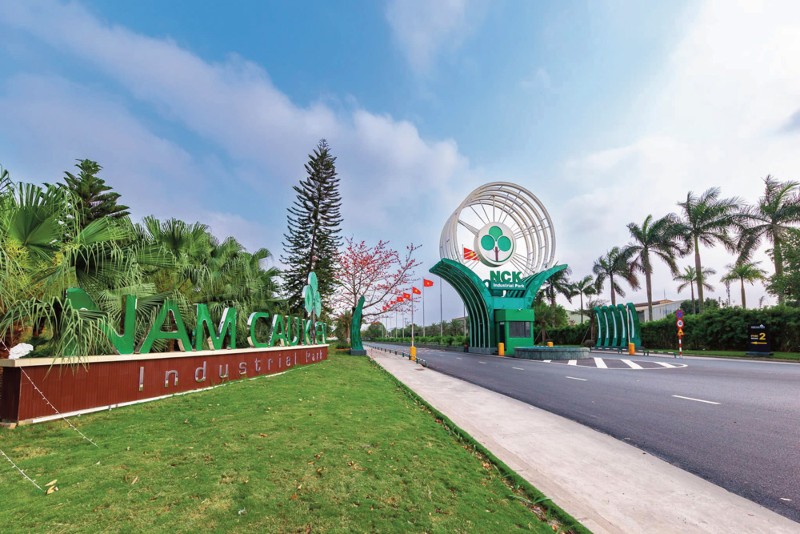
Speaking at Conference Session 1 of the Vietnam Industrial Park Summit 2026, with the theme “Planning, Construction, and Operation of Industrial Park Technical Infrastructure Toward Green, Circular, and Sustainable Criteria,” Mr. Vu Manh Hung, Director General of the Department of Sectoral Economics and Member of the Scientific Council at the Central Commission for Policy and Strategy, said developing green industrial parks (IPs) is no longer optional. “This is an inexorable requirement to realize the Party and State’s major policies on industrialization and modernization in tandem with green growth, the circular economy, innovation, and digital transformation,” he told participants.
National competitive advantage
IPs have played a pivotal role in Vietnam’s socio-economic development over the past several decades, he continued, serving as a key driver of FDI attraction, exports, economic restructuring, job creation, and State budget revenue. They have also strengthened links between domestic enterprises and multinational corporations, enabling Vietnam to integrate more deeply into global value chains.
According to the Foreign Investment Agency at the Ministry of Finance, Vietnam had 485 IPs covering 145,910 ha as of December 2025. Of these, 326 were in operation, with an average occupancy rate of 77 per cent. Multi-sector industrial parks account for 84.5 per cent of the total. After eight years of implementing eco-industrial parks (eco-IPs), only three have been officially certified by local authorities, or just 0.61 per cent of the total.
Mr. Hung added that the current development model still faces significant shortcomings. Most IPs have expanded extensively rather than intensively, while the quality and integration of technical infrastructure remain inadequate. Connectivity with regional infrastructure, urban areas and logistics networks also remains limited. At the same time, mounting pressure on land, natural resources, and energy, alongside increasingly stringent emissions reduction requirements, means the traditional model is no longer sufficient.
As Vietnam simultaneously advances green, digital, and energy transitions while pursuing a new growth model, IP infrastructure must be viewed through an entirely different lens. “IP infrastructure is no longer merely a physical foundation for production,” Mr. Hung said. “It must become a decisive factor in the competitiveness of the entire economy.”
To accelerate the transition, the Central Commission for Policy and Strategy proposed five key priorities.
First, Vietnam should clearly define a next-generation IP model aligned with the national industrial development strategy, green growth strategy, circular economy, digital economy, and climate adaptation objectives, while strengthening links between IPs, urban areas, economic zones, and economic corridors.
Second, requirements for energy efficiency, resource efficiency, circular economy principles, and climate resilience should be integrated into the planning process from the outset. Green and eco-IP standards and technical regulations should also be developed alongside industrial symbiosis and resource reuse models.
Third, digital technologies should be deployed more extensively in infrastructure management through data platforms, the Internet of Things (IoT), AI, and centralized control systems to optimize energy consumption, environmental monitoring, water supply, waste treatment, and operational safety.
Fourth, Vietnam should develop modern logistics infrastructure with seamless connections to seaports, airports, railways, and expressways, while establishing logistics centers and smart warehouses to lower costs and strengthen business competitiveness.
Finally, institutional reforms should encourage investment in green and digital infrastructure, expand green finance and green credit, refine tax and fee mechanisms, promote public-private partnerships (PPPs), and mobilize greater private and international financial resources.
“If implemented comprehensively, green IPs will become more than production hubs,” Mr. Hung said. “They will serve as the foundation for Vietnam’s new growth model, bringing together modern manufacturing, innovation, digital transformation, the circular economy, and sustainable development.”
Practical models
While policymakers have outlined the vision for next-generation IPs, businesses say success ultimately depends on translating those ambitions into practical operating models.
Mr. Hoang Tuan Anh, Vice Chairman of the Shinec JSC, the developer of the Nam Cau Kien Industrial Park in northern Hai Phong city, said Vietnam’s commitment to achieving net zero emissions by 2050, announced at COP26, is more than a national political pledge. It has become a powerful force driving companies to rethink their development strategies.
Several years ago, Nam Cau Kien adopted an eco-IP model built on three core pillars: green industry, the circular economy, and digital transformation. These principles now underpin its broader sustainable governance framework.
Rather than focusing solely on physical infrastructure, the IP has developed a management model centered on three priorities: sustainable governance supported by environmental, energy and resource monitoring systems; cleaner production that improves resource efficiency and reduces emissions; and industrial symbiosis among tenant companies.
The distinguishing feature of this model is that waste or by-products from one company become raw materials for another. Shared infrastructure and common services are also developed to optimize costs and create value across the entire IP, rather than maximizing efficiency for individual businesses alone.
According to Mr. Anh, the efforts of infrastructure developers alone are insufficient to build a genuine eco-IP. Success depends on coordinated participation from four stakeholders: the government, providing a clear legal and policy framework; infrastructure developers, acting as coordinators; tenant companies, actively participating in industrial symbiosis; and local communities, supporting environmental protection.
From the perspective of sustainability standards, Mr. Douglas Snyder, Executive Director of the Vietnam Green Building Council (VGBC), said one of Vietnam’s biggest gaps is the absence of an independent IP assessment system with clear criteria aligned with international standards.
He said existing regulations have laid an important foundation for eco-IP development but remain largely compliance-based. Meanwhile, businesses and financial institutions increasingly require measurable environmental, social, and governance (ESG)-based standards that support performance assessment, certification, capital raising, and competitiveness.
To address that need, the VGBC has developed the LOTUS Industrial Park certification system, the first certification framework designed specifically for Vietnam’s IPs. The framework references international standards, including the UNIDO Eco-Industrial Park Framework, GRI, the World Green Building Council, the ASEAN Taxonomy, and the Vietnam Green Taxonomy. “These criteria are designed not only to reduce emissions but also to strengthen IPs’ access to green finance while meeting the expectations of investors and global supply chains,” Mr. Snyder said.
He added that renewable energy, green buildings, carbon management in construction materials, water reuse, waste reduction, and digital technologies should all be incorporated into IP planning and operations from the outset. “Every IP should establish a decarbonization roadmap through 2050 starting today, because the net zero target cannot be achieved through short-term measures alone,” he concluded.




 Google translate