


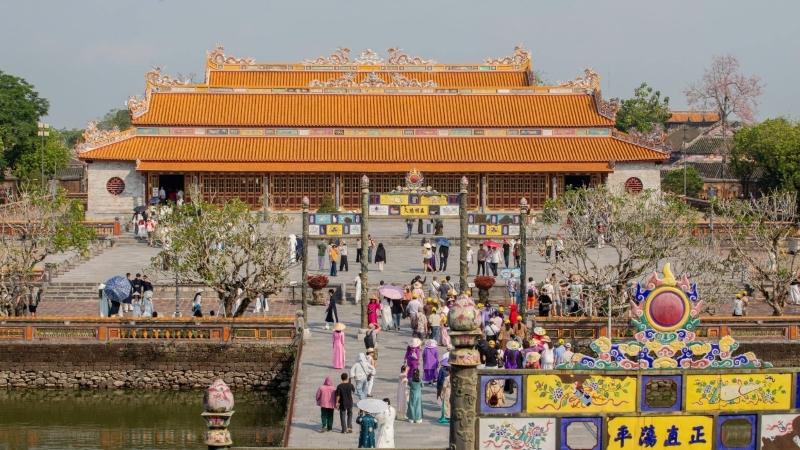
Vietnam’s tourism industry has firmly moved beyond its post-pandemic recovery phase, with international arrivals surpassing pre-Covid levels and domestic travel numbers continuing to surge. The country welcomed more than 21 million foreign visitors in 2025, marking a full restoration of tourism demand after years of disruption. Yet beneath the strong headline numbers, deeper structural questions are beginning to emerge about how sustainable this growth truly is.
A new industry analysis, “Vietnam Travel Landscape 2026: From Recovery to Resilience,” published by The Outbox Company, argues that the industry has entered a critical transition point. While the recovery in visitor numbers has been impressive, the report suggests that Vietnam’s tourism model remains heavily dependent on a narrow group of source markets, price competitiveness, and policy-driven demand rather than strong brand differentiation or high-value travel experiences.
According to the report, the challenge facing Vietnam’s tourism industry in the years ahead is no longer about restoring growth, but about managing it more strategically. As the country moves into the next phase of development, policymakers and businesses alike will need to focus on diversifying markets, improving visitor spending, and strengthening the destination’s global brand in order to build a more resilient tourism economy.
Recovery completed
Vietnam’s tourism industry entered 2025 with strong momentum as international travel demand continued to rebound and domestic tourism remained resilient. By the end of the year, the country had welcomed an estimated 21.1 million international visitors, exceeding the 2019 pre-pandemic benchmark by nearly 20 per cent and confirming that the recovery phase had effectively been completed.
However, the report notes that this milestone also marks the beginning of a new phase for the industry. The rapid growth seen in the early years after borders reopened is now giving way to a more normalized expansion pattern. Monthly year-on-year growth in international arrivals remained positive throughout 2025 but showed increasing variability as the effects of the recovery cycle began to fade. In other words, the surge in visitor numbers was driven less by new demand and more by the final stages of restoring pre-pandemic travel patterns.
Much of this rebound was concentrated in Northeast Asian markets that have long dominated Vietnam’s inbound tourism. The reopening of China played a particularly important role, helping drive a sharp increase in arrivals and restoring a familiar structure to Vietnam’s tourism demand. By 2025, China once again became the country’s largest source market, while South Korea continued to rank among the top contributors.
Despite the impressive recovery in overall volumes, the report underlined that Vietnam’s inbound tourism structure has changed very little. The same core markets continue to account for the majority of arrivals, with the Top 5 representing roughly 55 per cent of total international visitors. This suggests that the post-pandemic rebound occurred largely within Vietnam’s existing market “comfort zone” rather than through significant diversification into new markets.
As a result, the country’s tourism growth in 2025 reflected a transition from recovery-driven expansion to what the report describes as “structurally normal” growth - a stage in which the industry has regained scale but still faces underlying constraints that could shape its long-term competitiveness.
High volume, limited value
While Vietnam’s tourism industry has successfully restored visitor numbers, the report suggests that the recovery has been driven largely by volume rather than by higher value creation. Tourism revenue has risen alongside arrivals, but spending per visitor has not increased significantly enough to signal a shift towards higher-yield tourism.
Tourism revenue stood at some $39 billion last year, up from about $30 billion in 2019. However, this increase has largely mirrored the rise in visitor numbers rather than reflecting a structural improvement in visitor spending. In contrast, during the early recovery period in 2023, tourism receipts nearly returned to pre-pandemic levels despite significantly fewer arrivals, suggesting that travelers at the time were spending more per trip. As arrivals accelerated in 2024 and 2025, revenue continued to grow but without a comparable increase in value density.
This trend highlights what the report describes as a volume-led recovery, where growth is driven by increasing visitor numbers rather than by premiumization or higher-quality tourism experiences. Without stronger growth in spending per traveler, the overall economic contribution of tourism risks remaining limited despite record arrivals.
At the same time, domestic tourism has emerged as a crucial stabilizing force for the industry. In both 2024 and 2025, tourism revenue was split almost evenly between international and domestic sources, illustrating the dual structure of Vietnam’s travel economy. Domestic travelers generated roughly 43-51 per cent of total tourism receipts, providing a steady stream of demand even as international markets fluctuated.
Domestic travel has also grown significantly in scale. The number of domestic trips last year reached approximately 135 million, representing a 59 per cent increase compared with 2019. This growth reflects a shift towards normalized, high-frequency travel behavior among Vietnamese consumers, with short getaways and self-planned trips becoming increasingly common.
Despite its importance in stabilizing the industry, domestic tourism is not a major driver of high-value growth. Most domestic trips remain relatively affordable, with the majority of travelers spending less than VND20 million ($765) per trip. As a result, the strength of the domestic market lies in its scale and predictability rather than in its spending power.
From recovery to resilience
As Vietnam’s tourism industry moves beyond the recovery phase, the report argues that its main challenge is no longer restoring demand but managing structural risks. The strong rebound in visitor numbers has revealed several vulnerabilities, particularly the heavy concentration of source markets and the limited depth of Vietnam’s destination brand.
One of the most significant risks is, as mentioned, market concentration, leaving the industry exposed to economic fluctuations, policy changes, and geopolitical tensions in a limited number of markets.
The report also highlighted the role of policy-driven demand. Measures such as visa facilitation have played an important role in accelerating tourism recovery, but they have also underscored how sensitive visitor flows can be to regulatory changes. When growth depends heavily on visa policies or other administrative incentives, demand can become fragile and easily reversible if conditions change.
Another structural challenge lies in the strength of Vietnam’s destination brand. Though the country enjoys relatively high levels of awareness and appeal among regional travelers, this recognition does not always translate into strong advocacy. The report notes that Vietnam’s destination Net Promoter Score (NPS) stands at 24.2; significantly lower than regional competitors such as Thailand and Singapore, whose scores exceed 50. This suggests that while many visitors are satisfied with their experience, fewer are motivated to actively recommend the destination to others.
According to the report, the next phase of tourism development will require Vietnam to shift from a recovery-driven model towards one built on greater resilience. This includes diversifying source markets beyond the traditional Northeast Asian core, strengthening the country’s destination brand through improved service quality and distinctive experiences, and placing greater emphasis on higher-value tourism offerings rather than simply increasing arrival numbers.
Domestic tourism, which has proven to be one of the industry’s most reliable stabilizers in recent years, may also play a strategic role in this transition. The report suggests that the domestic market can serve as a testing ground for new tourism products, pricing strategies, and service improvements before these innovations are scaled up for international visitors.
As the report states, “Vietnam needs to transition from a volume-led recovery to a balanced, diversified, and value-driven approach to growth.” Without such a shift, it warns, the country risks continuing to experience “high tourist arrivals with low resilience.”







 Google translate