


The Ministry of Agriculture and Environment has previously described the Middle East as a large and promising market for Vietnam’s agricultural products. Indeed, agricultural exports to the region increased 22.5 per cent year-on-year in 2025, to $1.2 billion.
However, the escalating conflict in the Middle East is disrupting key Asia-Europe shipping corridors, driving freight costs up sharply, tightening insurance conditions, and raising the risk of supply chain disruptions, which all put mounting pressure on Vietnamese exporters of agricultural and seafood products.
Most Vietnamese exports to Europe, Africa, and part of the US normally pass through the Red Sea, the Suez Canal, and the Strait of Hormuz. Any disruption along these critical maritime routes will raise shipping costs, extend transit times, and directly affect export activities.
Dual risks
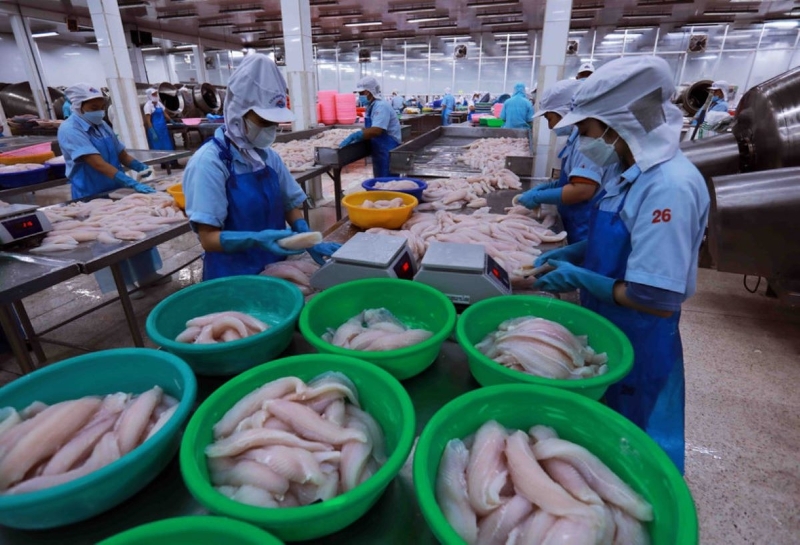
The Vietnam Association of Seafood Exporters and Producers (VASEP) said seafood exports to the Middle East stood at $401 million last year, up 9.6 per cent against 2024. Exports to the region nearly doubled in the 2020-2024 period, highlighting the solid potential of a market characterized by high purchasing power and stable import demand.
Growth has been driven mainly by pangasius (catfish) exports, with value reaching $175.9 million, up 18.6 per cent, shrimp $54.5 million, up 19.9 per cent, and other ocean fish, up 28.6 per cent. Tuna and pangasius remain the two leading products, accounting for around 70 per cent of total export value to the region.
Canned and pouch-packed tuna in oil or brine has gained popularity among consumers in Israel, the United Arab Emirates (UAE), Saudi Arabia, and Qatar due to competitive prices and reliable supply.
According to a representative from the LuLu Group in the UAE, Vietnam’s fresh produce and processed foods are highly regarded in Middle Eastern markets for their quality, particularly cashew nuts, coffee, and spices, thanks to product diversity and stable supply capacity.
However, in late February and early March, the sharp escalation of tensions along the Iran-Israel axis, coupled with the involvement of the US, cast a shadow over regional trade. In just a short period of time, military tensions translated into a shock for maritime transport and insurance markets in the Middle East.
For the seafood industry, which depends heavily on maritime logistics and cold chains, the impact goes beyond rising costs. Risks of cold chain disruption, shortages of refrigerated containers, and price fluctuations across product segments are emerging concerns, according to VASEP.
The focal point of risk lies in the Strait of Hormuz, a strategic maritime corridor linking the Persian Gulf with the Indian Ocean. As security warnings intensify, several international shipping lines have adjusted operations, requiring vessels to anchor in safer waters and temporarily suspending some routes through the area.
Some Asia-Europe shipping routes have already been diverted around the Cape of Good Hope at the southern tip of Africa instead of passing through the Red Sea - Bab el-Mandeb - Suez Canal corridor. The detour adds 7-14 days to transit times, reducing fleet efficiency and causing shortages of container equipment, particularly refrigerated containers that require higher technical standards and have slower turnaround times.
Freight rates on the Asia-Dubai route nearly doubled within a few days. War-risk surcharges ranging from $1,500 to $4,000 per container are now being applied, with refrigerated containers facing higher fees.
For seafood exporters, these additional charges directly increase production costs and narrow profit margins already under pressure from fluctuations in raw material prices and exchange rates.
At the same time, the maritime insurance market has reacted strongly. Some war-risk and ship-owner liability insurers have announced reductions or cancellations of coverage for vessels operating in Iran and the Persian Gulf, often with very short validity periods.
Notably, even cargo that does not directly pass through conflict zones may incur higher costs if vessels in the shipping chain call at ports located in areas considered high-risk.
In addition to logistics costs, fluctuations in fuel prices are adding financial pressure on exporters. “In previous conflicts involving Israel, seafood exports experienced certain impacts,” a representative from VASEP said. “However, the current situation is considered more serious due to the broader scope of influence and the rapid chain reaction in transport, insurance, and energy markets. If tensions persist, seafood exports to the Middle East could face not only localized disruptions but also ripple effects across related international trade routes.”
Close watch on developments
Military tensions involving the US, Israel, and Iran are also prompting Vietnamese exporters of pepper, spices, cashews, and fruit and vegetables to closely monitor developments and adjust delivery plans. Their biggest concern is the potential surge in shipping and logistics costs if the conflict continues.
Mr. Le Viet Anh, Secretary General of the Vietnam Pepper and Spice Association (VPSA), said many companies are concerned that sea freight rates could rise as some shipping routes are adjusted or suspended. If risks along traditional corridors increase, vessels may be forced to reroute, adding surcharges and transshipment costs.
The Middle East currently accounts for about 15 per cent of Vietnam’s total pepper and spice exports, equivalent to around 35,000-40,000 tons annually. Because shipments are distributed throughout the year, immediate pressure remains manageable, but businesses still hope tensions will ease quickly to avoid long-term impacts.
The cashew sector is also facing indirect effects. Mr. Ta Quang Huyen, General Director of the Hoang Son 1 Joint Stock Company in southern Dong Nai province, said the company currently has several containers of cashew nuts en route to the Middle East. These shipments typically pass through the Suez Canal - Red Sea corridor to reach markets such as Jordan, Israel, and Turkey. If risks increase, vessels may be forced to detour around the Cape of Good Hope, extending transit times by 8-10 days. In that case, war-risk insurance premiums and fuel costs would also rise. Logistics expenses currently account for around 10-20 per cent of total costs for exports to the Middle East and could increase by another 15-25 per cent if tensions persist.
Air freight has also been affected. Several cargo flights to the Middle East have been canceled, forcing exporters of fresh fruit to seek alternative transport options as delivery delays could affect product quality. Meanwhile, any cautious sentiment among importers in signing contracts and making payments could also create ripple effects across Vietnam’s exports to the broader Middle East region if the conflict drags on.
Safeguarding export flows
Amid the complex developments in the Middle East, several agricultural associations have urged exporters to quickly develop long-term contingency plans while diversifying export markets to mitigate the impact if trade with Israel, Iran, and other regional countries faces disruption.
Experts say identifying alternative markets with similar demand profiles is an urgent matter as geopolitical risks intensify. Businesses are also advised to closely analyze the situation and regularly exchange information with relevant ministries and agencies on import-export data, geopolitical developments, shipping conditions, freight rates, and surcharges, to coordinate timely response measures. Alongside market expansion, exporters should carefully review logistics, shipping, delivery, and insurance clauses in contracts.
Shipping agreements should clearly define force majeure provisions, compensation responsibilities, and mechanisms for sharing additional costs in the event of unforeseen disruptions. At the same time, securing comprehensive cargo insurance is considered a key measure to minimize losses should risks materialize in destination markets.
In an increasingly volatile global trade environment, proactive and flexible strategies will be critical for Vietnamese agricultural and seafood exporters to maintain stable export operations and safeguard sustainable growth.





 Google translate